How to Safely Stop GLP-1 Peptides Without Regaining Weight | Peptex
Published: 2025-12-09 20:55:00 | PEPTEX Research
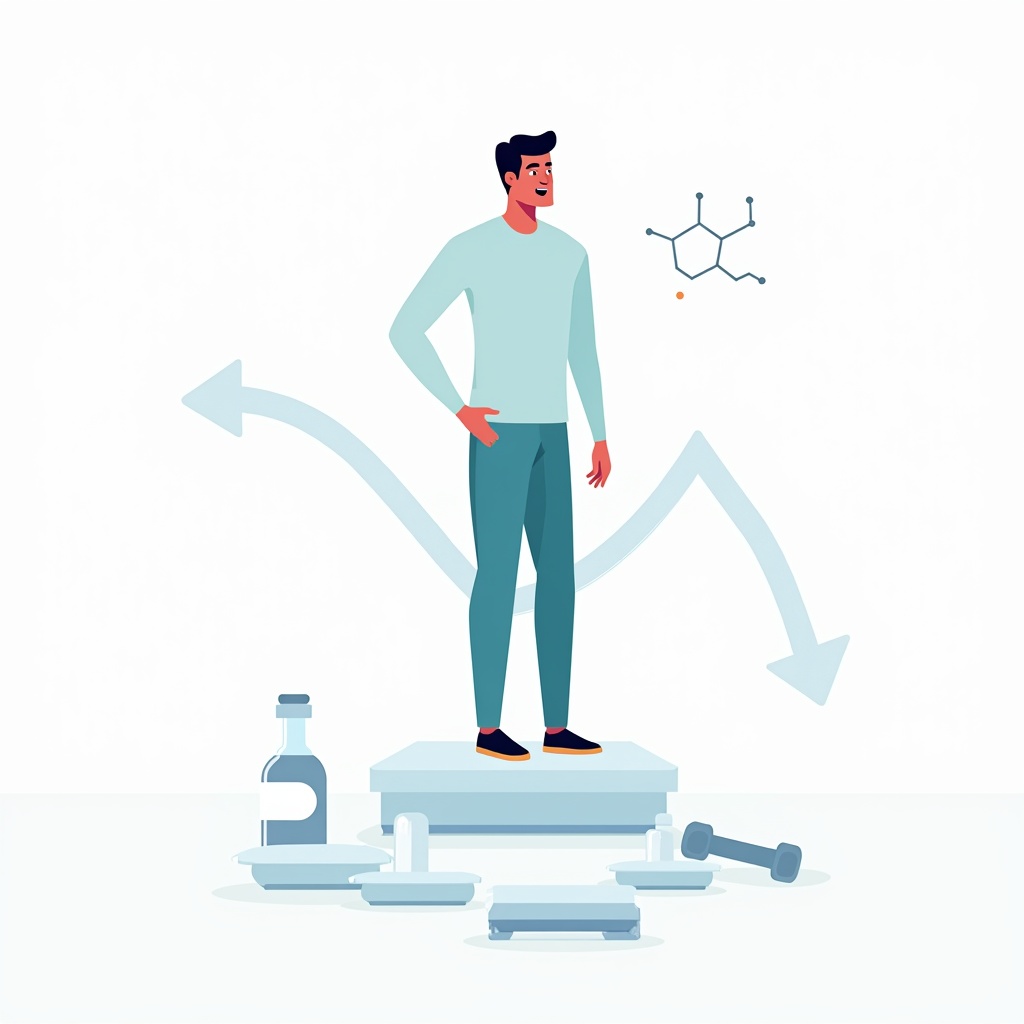
The Statistic Nobody Wants to Hear
You dropped 30, 40, maybe 55 pounds on [[Tirzepatide|10]] or [[Retatrutide|11]]. The mirror finally shows someone you recognize. Lab work looks clean, energy is up, your doctor is pleased. Then the question lands: "Am I going to inject this forever?"
Fair question. And there is an answer — but it demands preparation, not just determination.
The STEP-1 extension trial painted a sobering picture: roughly two-thirds of participants regained a significant portion of lost weight within 12 months of stopping therapy. Two out of three. That is not a handful of outliers. That is biology following its own playbook.
Pathologist Dr. Amin Hedayat broke this mechanism down in a video that almost four million people watched. His explanation is worth understanding in full, because once you see why the body rebounds, you can see exactly how to counter it.
Four Reasons Weight Comes Back (None of Them Is Laziness)
Here is what happens inside the body when the GLP-1 peptide leaves the equation.
1. Ghrelin Doesn't Just Return — It Overshoots
Ghrelin is the hunger hormone. During therapy it is suppressed. You might expect it to simply return to its old baseline after discontinuation. It doesn't. A review in Endocrine Reviews (2021) documented the overshoot phenomenon: ghrelin rises above pre-treatment levels. The body acts as though it survived a famine and compensates with a buffer. You feel hungrier than you did before you ever started losing weight.
2. Appetite Recovers Faster Than Satiety
GLP-1 receptors sit in both the brainstem and the gut. The problem is that these systems come back online at different speeds after you stop the peptide. Central hunger signals reboot in days. Peripheral satiety signals from the gut take weeks to normalize. That creates a window where you want to eat, but the "stop, I'm full" mechanism is still lagging behind.
3. Muscle Mass Dropped — Metabolic Rate Followed
Any weight loss — on peptides, on a diet, on anything — takes some muscle with it. Muscle tissue is metabolically expensive: it burns calories simply by existing. Less muscle means a lower resting energy expenditure. You burn fewer calories at rest than you did at the same weight before you started losing. That is a measurable, objective difference.
4. Fat Returns Faster Than Muscle Rebuilds
The body is pragmatic. Adipose tissue is an energy reserve that gets restored first. Muscle is a costly luxury the body rebuilds slowly and reluctantly. This imbalance — preferential adipose regain — means that when you gain weight back after stopping therapy, you accumulate a disproportionate amount of fat and a disproportionately small amount of muscle. Body composition worsens even if the number on the scale stays the same.
This is the core insight: weight regain after GLP-1 discontinuation is not a discipline problem. It is chemistry. Hormones, receptors, metabolic adaptation. And you fight chemistry with tools, not willpower.
Rule 1: The Protein Floor Is Non-Negotiable
When appetite is suppressed by GLP-1 peptides, protein is the first macronutrient to disappear from the plate. Not by conscious choice — protein-rich food just feels like the heaviest, least appealing option. A chicken breast triggers a grimace. Cottage cheese sits untouched. Eggs feel too substantial.
Yet protein is the single thing standing between you and muscle loss.
Target: 1.5 grams of protein per kilogram of your goal body weight. Not current weight — goal weight. Aiming for 70 kg? That is 105 grams of protein per day. Every single day.
When solid food won't go down, workarounds exist:
- Clear whey isolate — drinks like water, doesn't feel like food. About 25 grams of protein per serving.
- Collagen peptides — dissolves into coffee, broth, anything. No taste, no texture.
- Essential amino acids (EAAs) — minimal volume, maximum muscle signaling.
Pay special attention to leucine. This amino acid directly triggers muscle protein synthesis. Think of it as a switch: as long as leucine is sufficient, the body gets the signal "do not break down this tissue." About 2.5 to 3 grams of leucine per meal — that is the threshold you need to clear every time you eat.
Rule 2: Resistance Training Is Mandatory, Not Optional
Cardio is great for your heart. But preserving muscle during and after GLP-1 discontinuation requires a completely different kind of stimulus.
Resistance training is a direct message to your body: "This muscle tissue is in use. Do not dismantle it." Without that signal, the body treats muscle as metabolic overhead and happily discards it.
Minimum: twice a week. Sweet spot: three to four sessions. A review in Sports Medicine (2023) demonstrated that even two resistance sessions per week dramatically reduces lean mass loss during weight loss.
Which exercises? Compound, multi-joint movements:
- Squats (or leg press)
- Deadlifts (or Romanian deadlifts)
- Bent-over rows (or pull-ups)
- Bench press (or push-ups)
- Overhead press
You do not need to live in the gym. You do not need to become a powerlifter. You need to give your muscles a regular reason to stick around. That single change alters the trajectory of your body after discontinuation.
Rule 3: Taper the Dose — Never Quit Cold Turkey
This is where the most common mistake happens. Someone decides they are done, stops injections overnight, and two weeks later hunger hits like a freight train.
The body is an adaptive system. Give it time to adapt.
Gradually reducing the dose of [[Tirzepatide|10]] or [[Retatrutide|11]] over 4 to 8 weeks accomplishes several things at once:
- Ghrelin rises gradually instead of spiking
- Satiety signals have time to recalibrate at each step down
- Metabolism stabilizes at its new set point
- Psychologically, you avoid the shock of sudden contrast
The exact tapering schedule depends on your dose, duration of therapy, and individual response. A standard approach: step down by one dose increment every one to two weeks. If hunger becomes unmanageable at a given step, hold there for an extra week and let the body catch up.
Using pen devices like [[Tirzepatide pen|36]] or [[Retatrutide pen|38]] makes precise dosing at each step easier — no manual volume calculations needed.
Rule 4: Fiber Becomes Your New Satiety Tool
While you are on a GLP-1 peptide, satiety is chemical. The compound slows gastric emptying, amplifies fullness signals, and dials down appetite at the brain level. As you taper, that chemical satiety fades.
What replaces it? Mechanical satiety.
Fiber is volume without calories. It fills the stomach, stretches the walls, and activates mechanoreceptors that send the same message to the brain: "It's full down here, stop eating." It is a blunt, ancient mechanism, but it works.
High-volume fiber sources to lean on:
- Oats — swell in the stomach, create a lasting sense of fullness
- Legumes (lentils, chickpeas, beans) — protein and fiber in one package
- Berries — low calorie density, high volume
- Psyllium husk — turns into a gel, fills the stomach
- Cruciferous vegetables — broccoli, cauliflower, cabbage
The transition strategy: as the peptide dose drops, the fiber content of every meal goes up. Chemical satiety gradually yields to mechanical satiety. The hungry gap between one and the other shrinks to a sliver.
Rule 5: Watch Your Mood — This Is Not a Minor Detail
This gets less airtime, but it matters. GLP-1 receptors exist beyond the gut and pancreas. They sit in the brain — including the nucleus accumbens, the hub of the reward system.
Some people on GLP-1 therapy notice reduced interest in things that used to bring pleasure. Food becomes indifferent — expected and even therapeutically useful. But sometimes that indifference spreads: to hobbies, to social connection, to motivation at large.
After discontinuation, the reverse can happen — an emotional bounce where the pleasure of eating returns with doubled intensity. Or the opposite — a muffled, flat state that lingers.
What to do:
- Track your mood the same way you track your weight
- If motivation drops and familiar activities lose their pull — that is a signal
- Talk to your physician. The tapering pace may need adjustment
- Do not write off emotional shifts as "just a mood"
This is not a side effect to endure. It is information to act on.
Supporting Peptides for the Transition Phase
Stopping GLP-1 therapy is a metabolic stressor. Not catastrophic, but real. Metabolism is reshuffling, energy balance is shifting, the body is recalibrating. This is a smart time to give it extra support.
[[NAD+|14]] is a direct precursor to cellular energy. When caloric intake is reduced (and during a taper it often stays below the original baseline), NAD+ helps mitochondria work more efficiently. Less fatigue, more fuel for training and daily activity. Also available as [[NAD+ pen|35]] for easier dosing.
[[GHK-Cu|24]] supports tissue remodeling. After significant weight...
💬 Комментарии