Peptides for Muscle — GH Secretagogues and Mass Growth | PEPTEX
Published: 2026-03-08 11:00:00 | PEPTEX Research
✓ Reviewed by: Eskina Yulia — Endocrinologist · April 2026
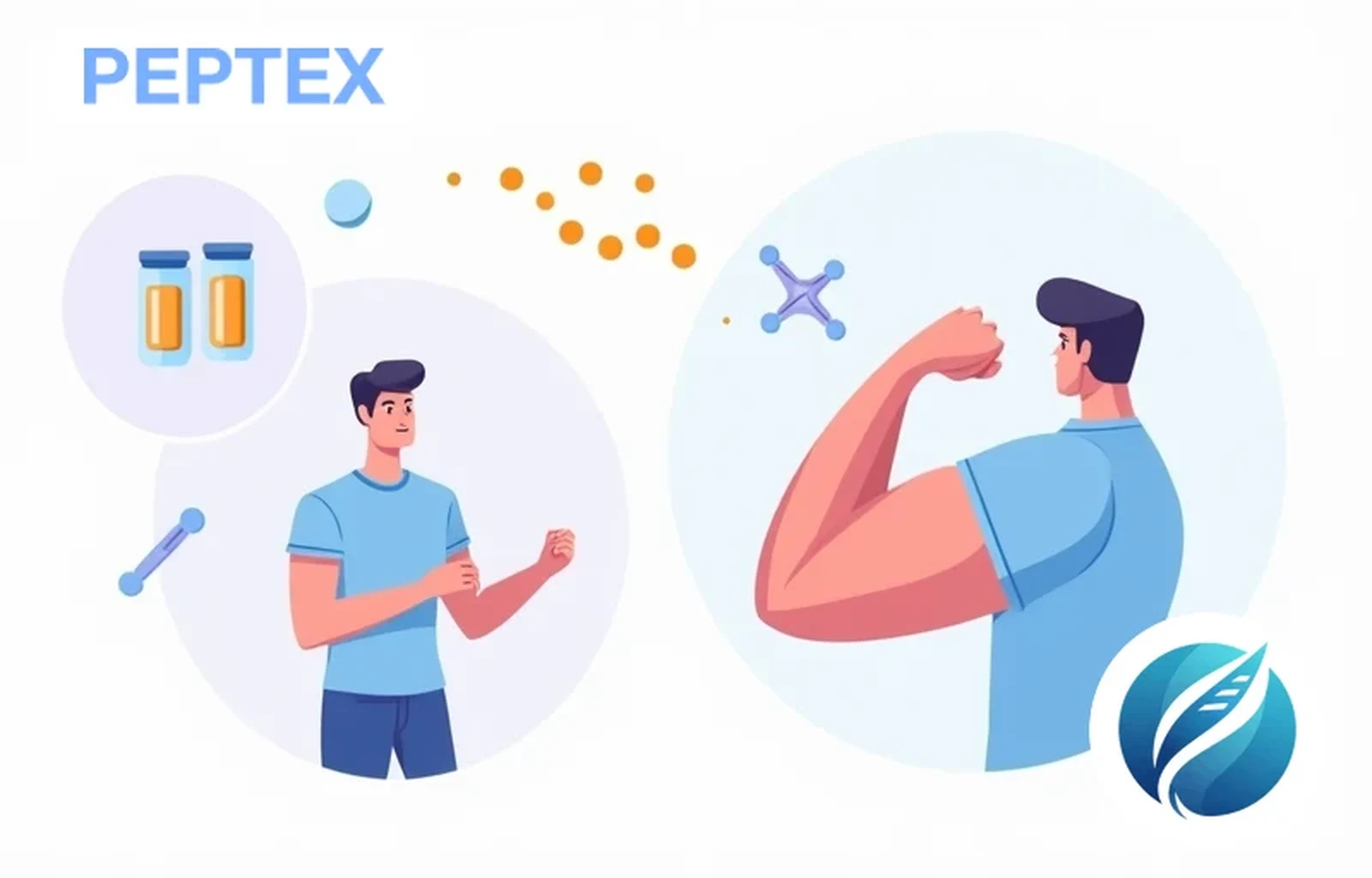
Muscle-growth peptides are not "light steroids" and not a replacement for testosterone. They are a class of molecules acting at the pituitary and on the GH/IGF-1 axis, where the main task is to restore physiological pulses of the body's own growth hormone. Unlike exogenous somatotropin, secretagogue peptides (ipamorelin, CJC-1295, tesamorelin) do not suppress the hypothalamic-pituitary loop — they amplify it. That is why in 2026 they have become the tool of choice for athletes, researchers, and clinicians working with sarcopenia, recovery, and body recomposition. Below — a complete practical guide from mechanisms to 12-week protocols, comparison tables, and a myth-buster.
Interest in GH secretagogues has grown sharply since 2015–2024, when dozens of randomized trials and meta-analyses confirmed their safety and physiological profile. Unlike classic anabolic steroids, they do not bind androgen receptors, do not suppress HPTA, do not cause gyno, acne, or testicular atrophy. Yet objective efficacy on lean-mass gain, visceral-fat reduction, and sleep quality has been demonstrated in clinical work. The protocols in this article are based on real research-grade dosing and European anti-aging practice from 2023–2026.
Why muscle peptides are primarily the GH axis
Muscle hypertrophy is not just about testosterone and creatine. The key anabolic signal for an adult is IGF-1, which the liver synthesizes in response to somatotropin (GH) pulses. After age 25–30, nighttime GH-pulse amplitude drops about 15% per decade, and by 50 more than halves — see PubMed 18719052.

Secretagogue peptides bring that amplitude back toward early-adult levels without any exogenous GH. That is the fundamental difference from recombinant somatotropin: your own pituitary keeps working, negative feedback is preserved, tachyphylaxis risk is minimal. Safety meta-review: PubMed 22669689. Related: healing peptides, recovery protocol, inflammation guide.
IGF-1 acts via the IGF-1R on muscle-fiber membranes, triggering the PI3K/Akt/mTOR cascade — the molecular pathway responsible for ribosomal translation, myofibrillar protein synthesis, and fiber cross-section growth. IGF-1 also activates satellite cells — local muscle stem cells that fuse with damaged fibers and donate extra myonuclei. More nuclei means a higher ceiling on protein synthesis within a fiber. That is why sustained high IGF-1 over 8–12 weeks produces durable mass gain, not merely temporary water retention.
Another important dimension is connective-tissue remodeling. GH and IGF-1 stimulate tenocyte and fibroblast proliferation, increasing type I and III collagen synthesis. This matters especially for athletes over 35, whose tendons heal 2–3× slower than muscle. The connective-tissue effect is typically felt by weeks 4–6 as quieter joints and less post-training stiffness.
Two receptor axes: GHRH and GHSR
The pituitary responds to two independent inputs. Understanding this architecture is key to why stacks outperform single peptides.
GHRH axis (CJC-1295, tesamorelin, sermorelin)
GHRH receptor is activated by hypothalamic GHRH. Synthetic analogues mimic the natural ligand but resist DPP-IV. CJC-1295 without DAC has a ~30-minute half-life; with DAC — up to 8 days. Tesamorelin is a stabilized GHRH(1-44), FDA-approved for HIV lipodystrophy (PubMed 19734430). The GHRH route adds a baseline tone and raises 24-hour GH AUC by 20–40%.
GHSR axis (ipamorelin, ghrelin mimetics)
GHSR is the ghrelin receptor. Its agonists create short sharp GH pulses of 30–60 minutes. Ipamorelin is the most selective — it does not raise cortisol or prolactin unlike hexarelin or GHRP-6 (PubMed 15531486). GHRH + GHSR synergy gives a 2–3× stronger GH spike than either alone — that is the basis of every gold-standard muscle stack.
Ipamorelin — selective GHSR agonist
Ipamorelin was discovered at Novo Nordisk in 1998 (PubMed 9849822, Raun et al.) as a pentapeptide with unique selectivity — only GHSR1a, no ACTH-cortisol or prolactin pathway involvement. Randomized data (PubMed 22584800) show IGF-1 +15–22% at 100–300 mcg over 6 weeks.
Ipamorelin suits beginners thanks to a gentle side-effect profile and no desensitization on cycles up to 16 weeks. Deep dive: Ipamorelin — who it is for, and mechanism foundations in BPC-157 review.
| Protocol | Dose | Frequency | Duration | Expected IGF-1 |
|---|---|---|---|---|
| Minimal | 100 mcg | 1×/day at bed | 8 weeks | +12–15% |
| Standard | 200 mcg | 1×/day at bed | 12 weeks | +18–22% |
| Advanced | 300 mcg | 2×/day | 12 weeks | +22–28% |
| Bridge | 150 mcg | 1×/day | 6 weeks | +15% |
CJC-1295 — long-acting GHRH
CJC-1295 with DAC was developed by ConjuChem in the early 2000s. The molecule covalently binds serum albumin through a DAC-lysine, giving a 6–8-day half-life (PubMed 12859969). This provides baseline GHRH stimulation between ipamorelin pulses.
Clinical data show 200–1000% mean GH increases and +45–65% IGF-1 on weekly 2 mg injections for 4 weeks (PubMed 10839993). For muscle growth, daily 100 mcg splits are preferred to keep pulses crisp. More: Tesamorelin vs CJC-1295.
| Version | DAC | Half-life | Dose | Frequency |
|---|---|---|---|---|
| CJC-1295 mod GRF(1-29) | No | ~30 min | 100 mcg | 1–3×/day |
| CJC-1295 + DAC | Yes | 6–8 days | 2 mg | 1×/week |
| CJC-1295 + DAC split | Yes | 6–8 days | 100 mcg | daily |
Tesamorelin — the high-potency option
Tesamorelin is the most clinically validated GHRH analogue. In the phase 3 HIV-lipodystrophy trial (PubMed 19734430), 2 mg tesamorelin daily for 26 weeks reduced visceral fat by 15.7% and raised IGF-1 by 81%. Meta-analysis (PubMed 27416104) confirms durability. Broader secretagogue review: PubMed 23846536.
For pure mass: 1 mg twice a day (morning + evening) SC for 12 weeks. Side-effect risk — insulin resistance requiring glucose monitoring. Deep dive: Tesamorelin — GHRH for visceral fat and GH and comparison in Ipamorelin vs Tesamorelin.
Comparison of the four main peptides
| Metric | Ipamorelin | CJC-1295+DAC | Tesamorelin | MK-677 (oral) |
|---|---|---|---|---|
| Axis | GHSR | GHRH | GHRH | GHSR |
| Half-life | 2 h | 6–8 days | 38 min | 4–6 h |
| Typical dose | 100–300 mcg | 100 mcg/day | 1–2 mg | 10–25 mg |
| IGF-1 rise over 12 wk | +18–22% | +25–35% | +40–81% | +40–89% (PubMed 29032278) |
| Lean mass gain | 1–2 kg | 2–3 kg | 2.5–4 kg | 2–3 kg |
| Fat loss | 1–3% | 3–5% | 10–16% | 2–4% |
| Cortisol impact | No | No | No | Mild |
| Insulin resistance | No | Mild | Moderate | Moderate |
| Route | SC | SC | SC | Oral |
| Best for | Beginners | Athletes | Recomp | Convenience |
CJC-1295 + ipamorelin remains the best price/effect/safety for 90% of users. See Ipamorelin + Tesamorelin — GH optimization.
Ready-to-use 12-week protocols

| Group | Protocol | Morning | Evening | Add-on |
|---|---|---|---|---|
| Beginners | Ipamorelin mono | — | 200 mcg SC | BPC-157 250 mcg under load |
| Athletes | CJC-1295 + Ipamorelin | — | 100+100 mcg SC | TB-500 2 mg 2×/week |
| Advanced | Tesamorelin + Ipamorelin | 1 mg tesamorelin | 200 mcg ipamorelin | HbA1c monitoring |
| Women | Ipamorelin low | — | 100 mcg SC | GHK-Cu for skin |
| 40+ | CJC-1295 + Ip...Read more: Peptides for Muscle — GH Secretagogues and Mass Growth | PEPTEX
ArticlesВведите корректный email
Введите имя и фамилию
▾
Get in touchChoose how you'd like to reach us
or email us
🎁
Special offer for youEnter your email and get 15% off your first order 🪙 Оплата криптовалютойШаг 1 из 2 — выберите валюту
Dosage Calculator
1
Loading...
💬
SupportChoose a convenient way to contact us Проверка подлинностиВведите серийный код с упаковки
0
Задания
⏳
⏳
FAQ⏳
|
💬 Комментарии