Dégradation des peptides : chaleur, lumière et agitation | Peptex
Publié : 2026-02-17 15:09:00 | PEPTEX Research
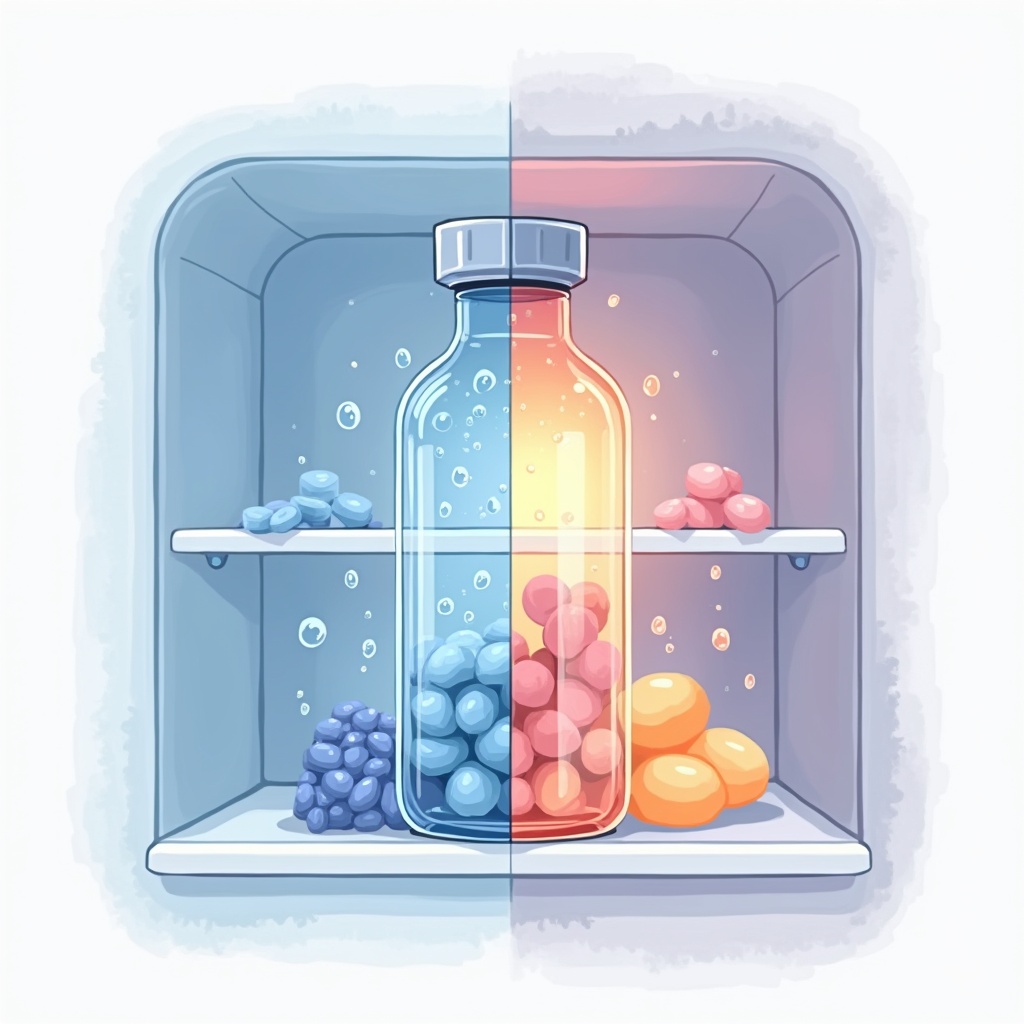
The Hidden Enemy of Your Peptide Investment
You spent real money on research peptides. You reconstituted them carefully, measured your dose, and followed the protocol to the letter. Three weeks in, the results stall. Not because the protocol was wrong — because the peptide sitting in your refrigerator has been quietly falling apart.
Peptide degradation is not dramatic. There is no color change, no obvious smell, no flashing warning sign. The molecule simply loses its tertiary structure, sheds amino acid bonds, and becomes a fraction of what it was. By the time you suspect a problem, you have already wasted weeks of a cycle and a significant portion of your supply.
This article covers the three primary degradation pathways — thermal damage, photodegradation, and mechanical stress — and provides concrete storage protocols that keep reconstituted peptides viable for 90 days or longer.
How Peptides Degrade: A Primer on Molecular Fragility
Peptides are short chains of amino acids held together by peptide bonds. Unlike small-molecule drugs, they rely on a specific three-dimensional shape to interact with their target receptor. Anything that disrupts that shape — unfolding, aggregation, or chemical modification — reduces bioactivity. In some cases, degradation products are not just inactive but can trigger unwanted immune responses at the injection site.
The three environmental factors that cause the most damage are heat, light, and physical agitation. Each one attacks the molecule through a different mechanism, and they often act in combination. A vial left on a sunny windowsill, for example, is getting hit by UV radiation and thermal energy simultaneously.
Thermal Degradation: Why Temperature Control Is Non-Negotiable
The Chemistry of Heat Damage
Heat accelerates two chemical processes that destroy peptides: deamidation and oxidation. Deamidation occurs when asparagine or glutamine residues lose their amide group and convert to aspartate or glutamate. This single amino acid change can reduce receptor binding affinity by 50-90%. Oxidation targets methionine and cysteine residues, producing sulfoxide derivatives that alter the peptide's folding pattern.
The Arrhenius equation governs reaction kinetics here: for every 10°C increase in temperature, the rate of chemical degradation roughly doubles. A vial stored at 25°C (room temperature) degrades approximately four times faster than one stored at 5°C. At 37°C — the temperature inside a car on a mild day — degradation proceeds eight times faster than refrigerated storage.
Lyophilized vs. Reconstituted: Different Vulnerabilities
Lyophilized (freeze-dried) peptides are significantly more stable than reconstituted solutions. The absence of water removes the medium through which most degradation reactions proceed. A properly sealed lyophilized vial stored at -20°C can retain over 95% potency for two years or more.
Once you add bacteriostatic water and create a solution, the clock starts ticking much faster. Water molecules participate directly in hydrolysis reactions that cleave peptide bonds. The benzyl alcohol preservative in bacteriostatic water inhibits microbial growth but does nothing to slow chemical degradation. Your reconstituted peptide is now in a race against thermodynamics.
Practical Temperature Guidelines
| Storage Condition | Lyophilized Stability | Reconstituted Stability |
|---|---|---|
| -20°C (freezer) | 24+ months | 6+ months* |
| 2-8°C (refrigerator) | 12+ months | Up to 90 days |
| 20-25°C (room temp) | 1-3 months | 3-7 days |
| 30-37°C (warm/car) | Days to weeks | Hours to days |
*Avoid repeated freeze-thaw cycles with reconstituted peptides. Each cycle forms ice crystals that physically damage the protein structure. If you must freeze reconstituted peptide, aliquot into single-use portions before freezing.
Shipping and Transit: The Forgotten Exposure Window
Most people focus on storage after the vial arrives, but shipping is often where the worst thermal exposure occurs. A package sitting in a delivery truck or on a porch in summer can reach internal temperatures above 50°C. Reputable suppliers ship lyophilized peptides with insulated packaging and cold packs. Peptex ships all peptide orders with thermal protection and includes bacteriostatic water packaged separately to prevent premature reconstitution from condensation.
Photodegradation: Light as a Silent Catalyst
UV and Visible Light Damage Mechanisms
Light-induced degradation of peptides occurs through two primary pathways. Direct photolysis happens when UV-B radiation (280-315 nm) is absorbed by aromatic amino acids — tryptophan, tyrosine, and phenylalanine. The absorbed energy breaks covalent bonds directly, fragmenting the peptide chain.
The second mechanism, photo-oxidation, is more insidious. UV-A and even visible light generate reactive oxygen species (ROS) — singlet oxygen, superoxide radicals, and hydroxyl radicals — that attack susceptible amino acid side chains. Histidine, methionine, cysteine, tryptophan, and tyrosine are all vulnerable. The resulting oxidized products not only lose biological activity but can cross-link with other peptide molecules, forming insoluble aggregates visible as cloudiness in the solution.
Which Peptides Are Most Light-Sensitive?
Any peptide containing tryptophan (Trp, W) residues is particularly photosensitive. BPC-157, for example, contains tryptophan and shows measurable degradation after just 4 hours of direct sunlight exposure. GHK-Cu is vulnerable through a different mechanism: the copper ion acts as a photocatalyst, accelerating free radical formation in the presence of light.
Even peptides without aromatic residues can degrade via photo-oxidation of methionine and cysteine. There is essentially no commonly used research peptide that is immune to light damage.
Protection Strategies
- Amber vials: Standard clear glass vials transmit UV and visible light freely. Amber glass blocks wavelengths below 450 nm, eliminating the most damaging UV-A and UV-B radiation. If your peptide arrives in a clear vial, wrap it in aluminum foil or store it in an opaque container.
- Minimize exposure time: Draw your dose quickly. Do not leave the vial out on a counter under kitchen lights while you prepare your injection. Each minute of exposure is cumulative.
- Refrigerator storage doubles as light protection: The interior of a closed refrigerator is dark. This is one reason refrigeration is so effective — it addresses both thermal and photodegradation simultaneously.
- Never store near windows: Even indirect sunlight carries significant UV energy. A vial on a bathroom shelf that receives reflected sunlight for 2-3 hours daily will show accelerated degradation within a week.
Mechanical Stress: The Damage You Inflict Yourself
Agitation-Induced Aggregation
This is the degradation pathway that most users create through their own handling. When you shake a reconstituted peptide vial — even briefly — you create air-liquid interfaces where peptide molecules unfold and aggregate. The hydrophobic interior of the peptide, normally shielded from water, becomes exposed at the air-water boundary. These partially unfolded molecules stick to each other, forming dimers, oligomers, and eventually visible particulates.
Insulin researchers documented this phenomenon extensively: vigorous shaking of insulin solutions for just 60 seconds produced measurable aggregation, with bioactivity dropping 15-30% in some formulations. The same physics applies to every peptide in your refrigerator.
Common Mistakes That Cause Mechanical Damage
- Shaking to dissolve lyophilized powder: When reconstituting, never shake the vial. Direct the stream of bacteriostatic water down the inner wall of the vial and let the powder dissolve passively. Gentle swirling is acceptable; vigorous shaking is not. Most properly manufactured peptides will dissolve within 2-5 minutes without any agitation.
- Rapid plunger movement during withdrawal: Pulling the syringe plunger too quickly creates localized vacuum and shear forces within the solution. Draw your dose slowly and steadily.
- Carrying vials in a pocket or bag: Walking, running, or traveling with a reconstituted peptide vial in your pocket subjects it to continuous low-level agitation. Over the course of a day, this accumulates to significant mechanical stress. Transport reconstituted peptides upright in a padded, insulated container.
- Dropping the vial: A single drop onto a hard surface generates enormous instantaneous shear forces throughout the solution. Even if the vial does not crack, the impact can cause measurable aggregation.
How to Reconstitute Without Damage
The proper reconstitution technique uses bacteriostatic water or acid water (for peptides that require lower pH, such as certain growth hormone secretagogues). Follow this sequence:
- Remove the flip-off cap and swab the rubber stopper with an alcohol wipe.
- Draw the calculated volume of solvent into a syringe. For most peptides, 1-2 mL per 5 mg vial is standard.
- ...
PEPTEX livre en France, Belgique, Suisse et Luxembourg — expédition rapide, qualité certifiée, livraison gratuite dès 150 €.
Lire la suite : Dégradation des peptides : chaleur, lumière et agitation | Peptex
💬 Комментарии