Peptidi per il recupero – Protocollo completo | PEPTEX
Pubblicato: 2026-02-20 10:30:00 | PEPTEX Research
✓ Revisionato da: Eskina Yulia — Endocrinologa · April 2026
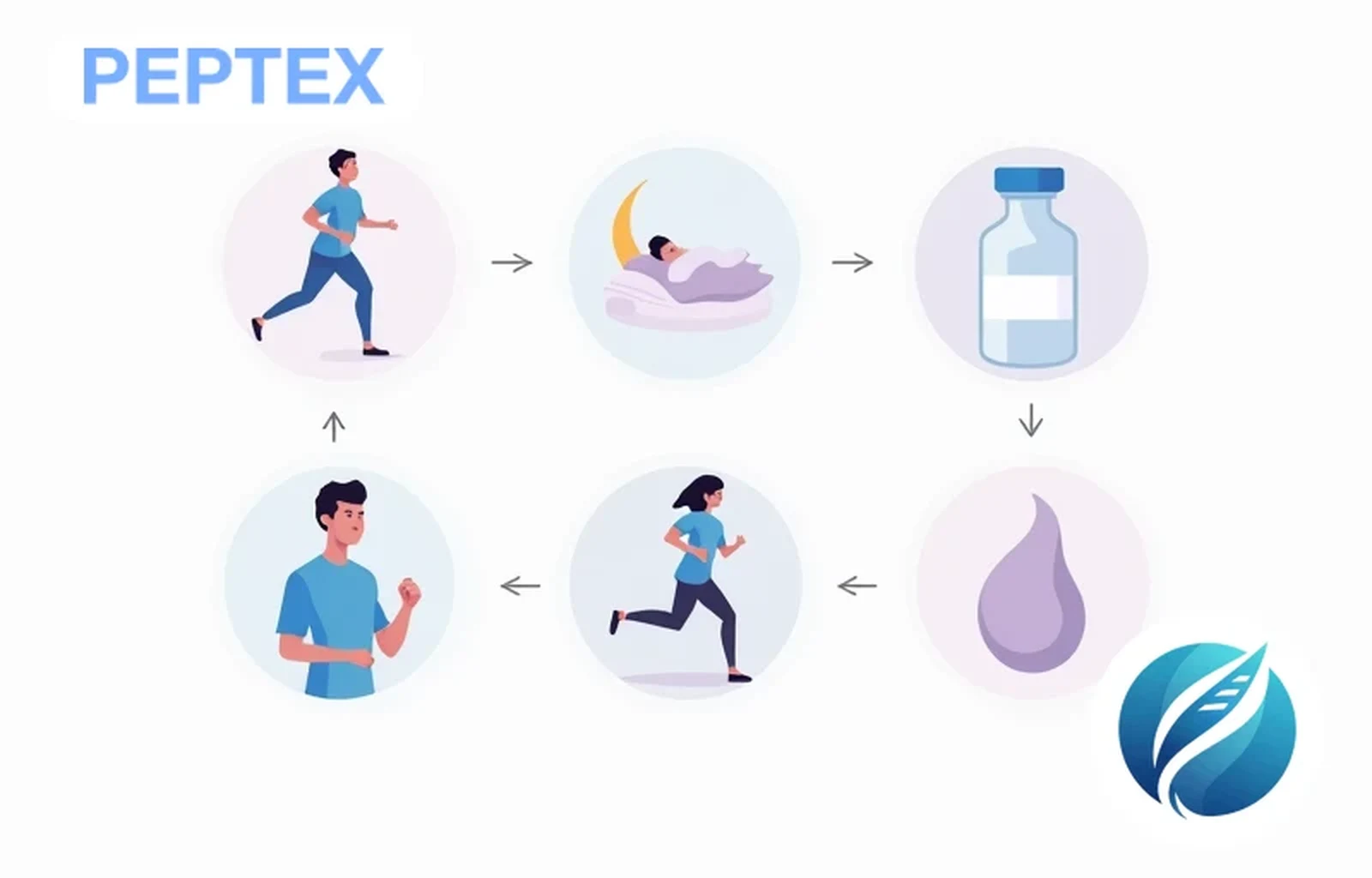
Recovery is not a pause between training blocks or a passive wait after injury — it is an active biochemical program in which tissue repair, metabolite clearance, energy-store replenishment, and remodelling all run in parallel. When one of these lags, the subjective picture is immediate: training stops producing progress, old injuries flare up, sleep becomes shallow. Research-model data on peptides show that each of these layers can be pushed independently through specific signalling pathways, without blunt systemic hormonal hammers. This article walks through peptide recovery protocols for research use in depth.
What recovery means at the biochemical level
At cellular level recovery is a superposition of four processes, each with its own kinetics and rate-limiting step. Mapping these phases explains why individual peptides show different speeds and different points of action in published research.
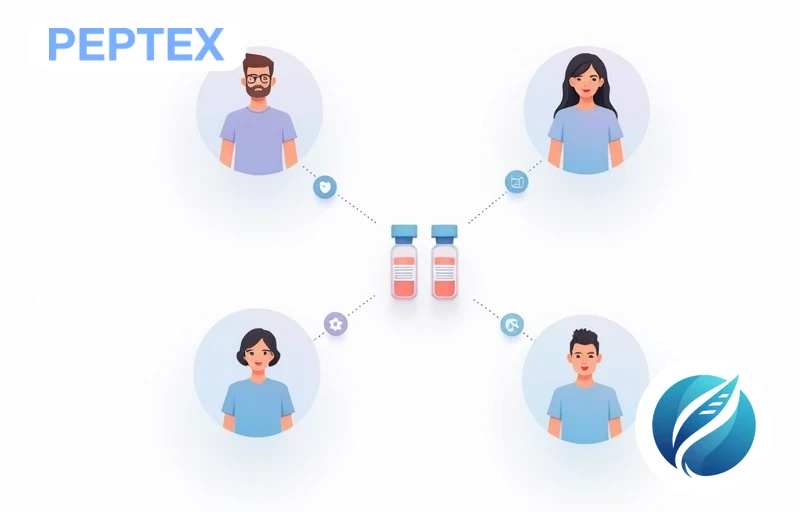
Phase 1. Tissue repair
Microtears in myofibrils, tendon strains, and epithelial damage trigger TNF-α, IL-6, IL-1β, neutrophil and macrophage migration, and fibroblast recruitment. The rate-limiting step is often not cell division but angiogenesis — how quickly new capillaries sprout into the injured zone. BPC-157 targets this stage in research models — PubMed 22087775.
Phase 2. Clearance of inflammatory mediators
Lactate, free iron, oxidised lipids, and DAMP molecules must be removed in parallel with repair. A delay here produces chronic smouldering inflammation typical of tendinopathy. TB-500 reduces NF-κB activity in models — PubMed 20237584.
Phase 3. Energy substrate refill
Glycogen resynthesis, creatine phosphate restoration, and amino-acid pool replenishment require an anabolic backdrop. The nighttime GH peak is the key endogenous trigger. Ipamorelin and tesamorelin restore physiological pulse amplitude in research — PubMed 9849822.
Phase 4. Remodelling
Collagen I deposited in the first week is poorly aligned. Over 3–12 weeks it is replaced by stronger collagen aligned to load lines, with recovery of mitochondrial density. GHK-Cu modulates >4000 remodelling-related genes in transcriptomic work — PubMed 26060406.
Four pillars of recovery and the peptides that hit each
A useful mental model: recovery rests on four independent pillars, and the weakest one sets the overall ceiling. Peptide protocols close several pillars at once and remove the bottleneck. For a broader survey see Peptides for healing: complete guide.
Pillar 1 — local repair
BPC-157 (vascular regeneration), TB-500 (progenitor cell migration), GHK-Cu (collagen, ECM). Side-by-side comparison in BPC-157 vs GHK-Cu.
Pillar 2 — sleep and nighttime regeneration
Epithalon is a short tetrapeptide that restores melatonin circadian amplitude and deepens SWS sleep in research. Without adequate sleep, GH secretagogues lose up to 60% of their effect. See Epithalon overview.
Pillar 3 — GH/IGF-1 axis
CJC-1295 is a long-acting GHRH analog; ipamorelin is a selective ghrelin-receptor agonist. Together they restore nighttime GH pulse amplitude. Details — ipamorelin + tesamorelin stack.
Pillar 4 — inflammation control
KPV (C-terminal fragment of α-MSH) suppresses macrophage activation and cytokine release in models. See KPV explained and the broader inflammation guide.
| Pillar | Rate-limiting step | Primary peptide | Effect horizon |
|---|---|---|---|
| Local repair | Angiogenesis, cell migration | BPC-157, TB-500 | 7–21 days |
| Sleep | Melatonin amplitude, SWS | Epithalon | 2–10 nights |
| GH/IGF-1 | Nighttime GH pulse | CJC-1295 + ipamorelin | 3–6 weeks |
| Inflammation | NF-κB, M1 macrophages | TB-500, KPV | 2–6 weeks |
First-line recovery peptides
Three molecules form the core of research recovery protocols — BPC-157, TB-500, and GHK-Cu. They differ in mechanism, speed, and optimal route, and in most protocols are complementary rather than redundant.
BPC-157: vascular basis of recovery
BPC-157 is a synthetic pentadecapeptide derived from a gastric protein. Its signature effect in research is acceleration of angiogenesis through VEGFR2 signalling and modulation of nitric-oxide metabolism. In an Achilles tendinopathy model, recovery was faster with BPC-157 — PubMed 20331389. It also shows cytoprotection of GI mucosa — PubMed 22087775, relevant to athletes with leaky-gut-type presentations — see gut-immune axis and IBS and gut barrier review. Mechanistic detail — BPC-157 mechanism and dosing and why BPC-157 heals faster.
TB-500: cell migration and deep injuries
TB-500 is a synthetic fragment of thymosin-β4. It accelerates keratinocyte and endothelial migration and mobilises marrow progenitors — PubMed 16036211. Tβ4 shows cardiac-repair signals — PubMed 17981560 and mechanism breakdown. Fragment-vs-full-length distinction — TB-500 vs TB-4. Tendon-injury data — PubMed 27383837; anti-inflammatory profile — TB-500 and repair.
GHK-Cu: collagen and matrix
GHK-Cu is the glycyl-histidyl-lysine tripeptide complexed with copper. Review work — PubMed 17307013; gene-expression profile — PubMed 26060406. In skin and scar research it is used topically more often than subcutaneously.
| Peptide | Typical dose | Frequency | Route | Course |
|---|---|---|---|---|
| BPC-157 | 250–500 mcg | 1–2×/day | SC near target zone | 4–8 weeks |
| TB-500 (loading) | 2–2.5 mg | 2×/week | SC or IM | 4 weeks |
| TB-500 (maintenance) | 2 mg | 1×/week | SC | 4–8 weeks |
| GHK-Cu SC | 1–2 mg | daily | SC | 6–10 weeks |
| GHK-Cu topical | 0.1% cream | 2×/day | topical | up to 12 weeks |
Reconstitution choices — see bacteriostatic water and acidic water for reconstitution.
Hormonal support: CJC-1295 + ipamorelin
The anabolic window after training is partly set by nighttime GH pulse amplitude, which in turn depends on an intact GHRH/ghrelin axis. Amplitude falls with age and chronic sleep debt — and even perfect nutrition stops delivering glycogen resynthesis and protein turnover at prior levels.

CJC-1295 is a GHRH analog with amino-acid substitutions for DPP-IV resistance. With DAC it remains active 5–8 days in research, and 6–8 hours without DAC — PubMed 12859969. Ipamorelin is a selective GHSR agonist that releases GH without meaningful cortisol/prolactin effects — PubMed 9849822. Choice guidance — ipamorelin vs tesamorelin; profile — who ipamorelin is for. Tesamorelin deep-dive — tesamorelin for visceral fat and tesamorelin vs CJC-1295. Phase-3 tesamorelin data — PubMed 19734430.
| Schedule | CJC-1295 | Ipamorelin | Timing | Goal |
|---|---|---|---|---|
| Baseline | 100 mcg | 100 mcg | before sleep | nighttime GH pulse |
| Double-peak | 100 mcg | 100 mcg × 2 | AM + PM | athletes, strength block |
| CJC... PEPTEX consegna in Italia e Svizzera — spedizione veloce, qualità certificata, consegna gratuita sopra 150 €. Leggi di più: Peptidi per il recupero – Protocollo completo | PEPTEXArticlesВведите корректный email
Введите имя и фамилию
▾
Get in touchChoose how you'd like to reach us
or email us
🎁
Special offer for youEnter your email and get 15% off your first order 🪙 Оплата криптовалютойШаг 1 из 2 — выберите валюту
Dosage Calculator
1
Loading...
💬
SupportChoose a convenient way to contact us Проверка подлинностиВведите серийный код с упаковки
0
Задания
⏳
⏳
FAQ⏳
|
💬 Комментарии