Bouwen peptiden spieren op? Op wetenschap gebaseerd antwoord
Gepubliceerd: 2026-03-31 18:32:00 | PEPTEX Research
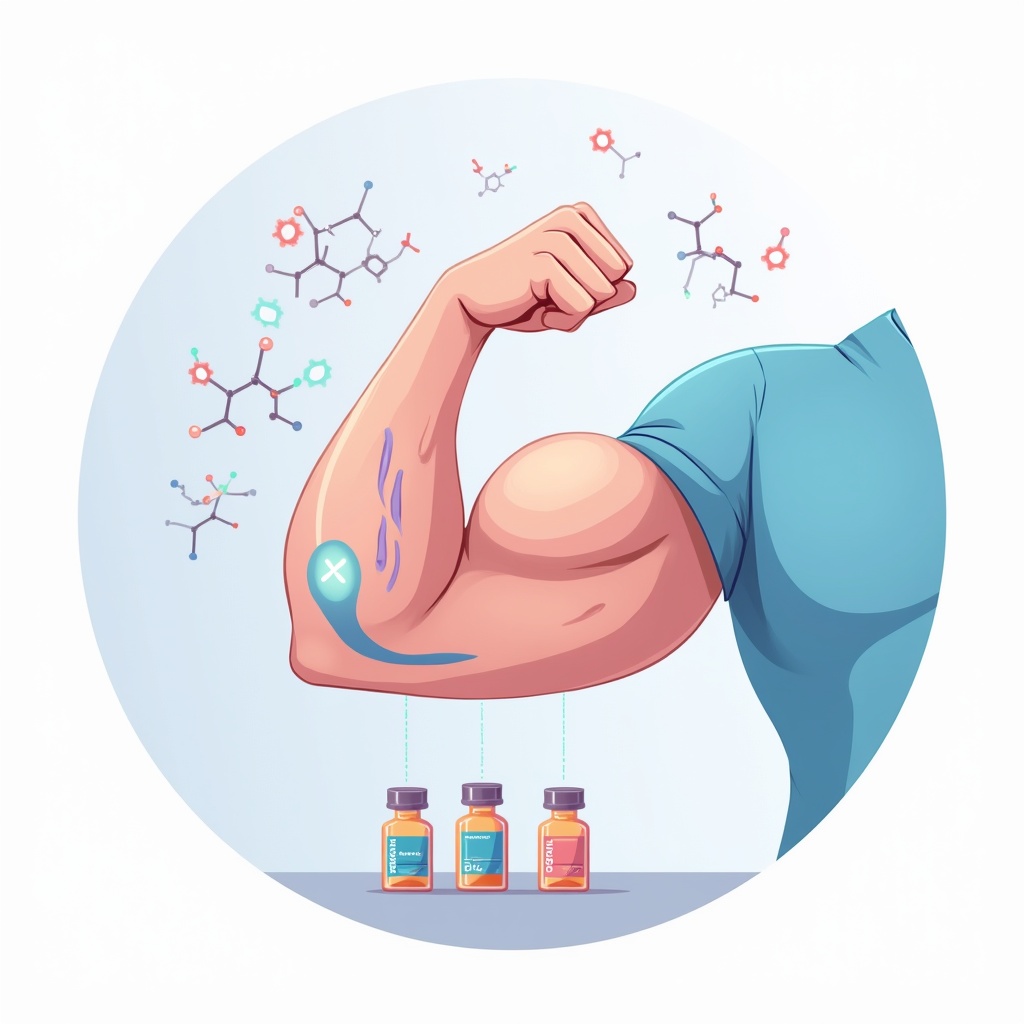
Walk into any gym and you'll hear someone mention peptides for muscle growth. Open a bodybuilding forum and the topic is everywhere. But strip away the hype and the marketing, and what does the actual research say? Can peptides build muscle, or are they just expensive placebo?
The honest answer: peptides don't build muscle the way anabolic steroids do. They work through a completely different mechanism. And that distinction matters more than most people realize.
How muscles actually grow
Muscle hypertrophy requires three things happening at once: mechanical tension from resistance training, adequate protein intake, and the right hormonal environment. Growth hormone, IGF-1, testosterone, and insulin all play roles. Remove any one piece and the system underperforms.
This is where peptides enter the conversation. They don't directly force muscle protein synthesis the way anabolic compounds do. Instead, certain peptides optimize the hormonal environment that supports hypertrophy. Think of it this way: anabolic steroids are the construction crew building the house. Peptides are the building inspectors who make sure the foundation, plumbing, and electrical are all working properly so the crew can do their best work.
Growth hormone peptides and lean mass
The most studied peptides for body composition are growth hormone secretagogues (GHS). These stimulate your pituitary gland to produce more of your own growth hormone, rather than injecting exogenous GH directly.
Ipamorelin: the selective GH pulse
Ipamorelin is a pentapeptide that binds to ghrelin receptors (GHS-R1a) in the pituitary. What makes it stand out from older GH secretagogues like GHRP-6 is its selectivity. It raises GH without significantly affecting cortisol, prolactin, or appetite.
Research shows ipamorelin increases GH levels by 200-300% above baseline. A 2009 study in the Journal of Endocrinological Investigation found that repeated ipamorelin administration maintained this GH elevation without tachyphylaxis (the diminishing response seen with some GH peptides over time).
What does that extra GH do for muscle? Growth hormone promotes lipolysis (fat breakdown for energy) and enhances amino acid uptake into muscle cells. It also stimulates hepatic IGF-1 production, which drives satellite cell activation and muscle repair. The result is better recovery, improved body composition (more lean mass, less fat mass), and enhanced capacity to adapt to training.
Key point: ipamorelin doesn't inject growth hormone. It makes your pituitary release more of what it already produces. This preserves the natural pulsatile pattern of GH secretion, which appears to matter for downstream effects on muscle tissue.
Tesamorelin: the GHRH analog
Tesamorelin works through a different receptor entirely. It's a synthetic analog of growth hormone-releasing hormone (GHRH), meaning it mimics the brain's own signal to produce GH. While ipamorelin works at the ghrelin receptor, tesamorelin works at the GHRH receptor. Different door, same room.
Tesamorelin is FDA-approved (as Egrifta) for reducing visceral adipose tissue in HIV-associated lipodystrophy. The clinical data is robust: a 2010 New England Journal of Medicine study showed a 15% reduction in visceral fat over 26 weeks, with increases in IGF-1 levels. Subjects also experienced improvements in trunk fat distribution and lipid profiles.
For muscle specifically, tesamorelin's value lies in the sustained GH and IGF-1 elevation it provides. IGF-1 is arguably more directly anabolic than GH itself. It promotes muscle protein synthesis, supports nitrogen retention, and enhances the proliferation of muscle satellite cells, which are essential for repairing and growing muscle fibers after training damage.
The ipamorelin + tesamorelin stack
Combining ipamorelin with tesamorelin is a well-established approach. The two peptides act on different receptors (ghrelin vs. GHRH), creating a synergistic effect that produces higher GH output than either one alone. Multiple clinical protocols use this combination because the dual-receptor stimulation yields a more robust and sustained GH pulse.
For body composition, this translates to more effective fat mobilization (especially visceral fat) while supporting lean tissue maintenance and growth. Combined with progressive resistance training, users consistently report improved recovery between sessions, better muscle fullness, and gradual recomposition over 8-12 week cycles.
MOTS-c: the metabolic peptide
MOTS-c is a 16-amino-acid peptide encoded in mitochondrial DNA. Unlike ipamorelin and tesamorelin, MOTS-c doesn't primarily act through GH. Its mechanism is fundamentally different: it targets cellular energy metabolism.
MOTS-c activates AMPK (AMP-activated protein kinase), the master sensor of cellular energy status. When AMPK is activated, it improves glucose uptake into muscle cells, enhances fatty acid oxidation, and improves insulin sensitivity. A 2015 Cell Metabolism study by Lee et al. showed that MOTS-c treatment prevented age-dependent and diet-induced insulin resistance in mice while improving physical capacity.
How does this connect to muscle growth? Through several mechanisms:
- Better nutrient partitioning. Improved insulin sensitivity means more of the carbohydrates and amino acids you eat end up in muscle cells rather than fat cells. Muscles get better fueled for training and better supplied for recovery.
- Enhanced exercise capacity. MOTS-c has been shown to improve endurance and physical performance in animal models. Better performance means more training volume, which is the primary driver of hypertrophy.
- Mitochondrial efficiency. Healthier mitochondria produce more ATP. More ATP means better muscle contractions, less fatigue during sets, and faster recovery between sessions. Over weeks and months, this compounds into meaningful differences in training quality.
- Anti-inflammatory effects. Chronic low-grade inflammation impairs muscle protein synthesis and accelerates muscle breakdown. MOTS-c's metabolic improvements reduce systemic inflammation, creating a more anabolic internal environment.
MOTS-c won't make your bench press go up by 20 kg overnight. But by improving the metabolic foundation your muscles operate on, it supports better long-term adaptation to training, especially in people over 30 whose metabolic efficiency starts declining.
What the research actually shows
Let's be specific about the evidence.
A 2017 systematic review in Growth Hormone & IGF Research examined 21 studies on GH secretagogues and body composition. The consistent finding: GHS peptides produce meaningful increases in lean body mass and decreases in fat mass when combined with exercise. The effect sizes are moderate, not dramatic. You're not going to gain 10 kg of muscle in 8 weeks.
The typical outcomes in controlled studies:
- Lean body mass increase: 1.5-3 kg over 12-16 weeks (above what training and diet alone produce)
- Fat mass decrease: 2-4 kg, with preferential reduction in visceral fat
- Recovery markers: reduced muscle damage markers (CK, LDH) post-exercise
- Sleep quality improvement: GH is primarily released during deep sleep; better sleep equals better recovery
These aren't earth-shattering numbers. But they represent a genuine physiological advantage that accumulates over time. Someone who recovers 15% faster can train with more frequency and volume. Over 6-12 months, that compounds substantially.
What peptides cannot do
Honesty requires stating what peptides won't accomplish:
- They won't replace training. No peptide builds muscle in the absence of mechanical stimulus. If you're not progressively overloading your muscles with resistance training, GH secretagogues will primarily improve your body fat ratio, not build new muscle tissue.
- They won't fix a bad diet. You need adequate protein (1.6-2.2 g per kg bodyweight) and sufficient calories to support hypertrophy. Peptides can improve nutrient partitioning, but they can't create amino acids from nothing.
- They aren't anabolic steroids. The magnitude of muscle gain from optimized GH levels is considerably less than from supraphysiological testosterone. Anyone expecting steroid-like results from peptides will be disappointed.
- They don't work instantly. GH-mediated body composition changes unfold over 8-16 weeks. Most users report the first noticeable effects (improved sleep, better recovery, reduced soreness) within 2-3 weeks, with visible composition changes taking 6-8 weeks.
Who benefits most
Peptides for muscle growth make the most sense for specific populations:
People over 35. Natural GH production declines roughly 14% per decade after age 30. By 50, you're producing significantly less GH than at 25. Restoring GH to more youthful levels has measurable effects on lean mass, fat distribution, and recovery capacity. This is where peptides show their clearest benefit.
Natural athletes who've plateaued. If you've been training consistently for 3+ years, eating properly, sleeping well, and your gains have stalled, optimizing your GH output can provide the additional edge needed to push past that plateau. Not a dramatic breakthrough, but a meaningful shift.
People focused on body recom...
PEPTEX levert in Nederland en België — snelle verzending, gecertificeerde kwaliteit, gratis levering boven 150 €.
Lees meer: Bouwen peptiden spieren op? Op wetenschap gebaseerd antwoord
💬 Комментарии