Biologische beschikbaarheid van peptiden: injecteerbare versus orale vergelijking
Gepubliceerd: 2026-01-31 10:12:00 | PEPTEX Research
The Bioavailability Problem Nobody Talks About
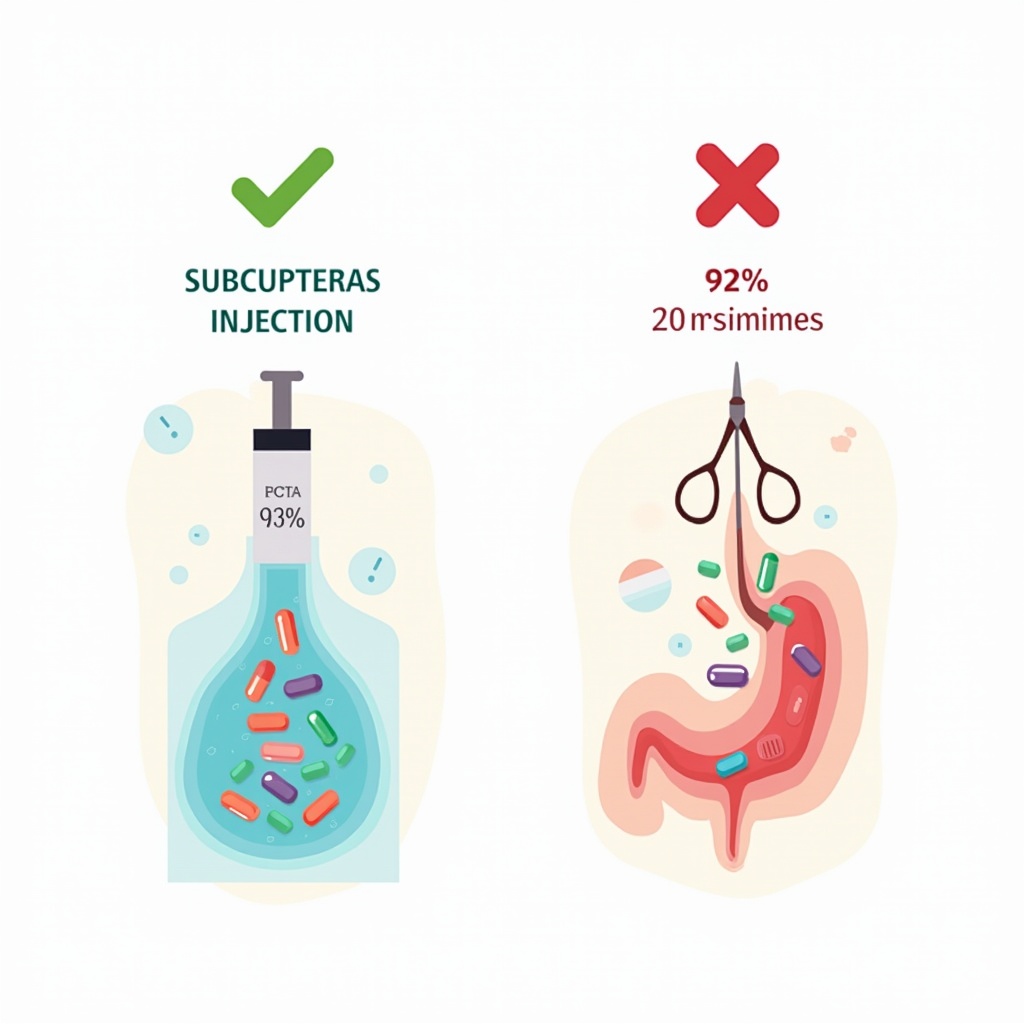
You swallow a 5 mg peptide capsule. Within forty minutes, pepsin has already carved it into fragments. By the time what remains crosses the intestinal wall and survives the liver's first-pass metabolism, less than 150 micrograms — roughly 2–3% of the original dose — reaches systemic circulation. That is not a rounding error. That is the difference between a therapeutic dose and an expensive placebo.
Peptide bioavailability — the fraction of an administered dose that enters the bloodstream in active form — sits at the center of every purchasing decision, every dosing protocol, and every complaint about "peptides not working." Yet most buyers never consider it. They compare milligrams on labels without asking the only question that matters: how much actually gets where it needs to go?
This article lays out the pharmacokinetics in plain language. No hand-waving, no marketing spin. Just the enzymatic gauntlet that oral peptides face, the numbers behind subcutaneous injection, and what it all means for anyone spending money on peptide-based compounds.
What Bioavailability Actually Measures
Bioavailability (F) is expressed as a percentage. Intravenous injection sets the benchmark at 100% because the substance enters the bloodstream directly. Every other route — oral, sublingual, nasal, transdermal, subcutaneous — is measured against that reference.
For small-molecule drugs like aspirin or metformin, oral bioavailability often lands between 40% and 90%. The molecules are small enough to survive stomach acid, resist enzymatic cleavage, and cross the intestinal epithelium via passive diffusion. Peptides share none of these advantages.
A typical therapeutic peptide is 5 to 50 amino acids long, with a molecular weight between 500 and 5,000 daltons. Anything above roughly 500 daltons struggles with passive absorption across the gut lining. At 1,000+ daltons, passive transcellular transport is essentially zero without a carrier mechanism. Most research peptides sit squarely in this dead zone.
The Enzymatic Gauntlet: Four Barriers to Oral Peptide Survival
Barrier 1: Gastric Proteolysis
The stomach maintains a pH between 1.5 and 3.5 during digestion. This environment activates pepsinogen into pepsin, an aspartic protease that cleaves peptide bonds with broad specificity — preferring hydrophobic residues like phenylalanine, tyrosine, and leucine, but attacking most exposed bonds given enough contact time.
Residence time in the stomach ranges from 30 minutes (fasted) to 4+ hours (fed state). Even with enteric coating designed to resist gastric acid, the coating itself introduces variability. It may dissolve too early in some individuals, or too late, releasing the peptide past the optimal absorption window in the upper small intestine.
Barrier 2: Pancreatic Protease Cascade
Surviving the stomach means entering the duodenum, where the pancreas delivers a concentrated cocktail of proteases: trypsin (cleaves after arginine and lysine), chymotrypsin (after aromatic and hydrophobic residues), elastase (after small nonpolar residues like alanine and glycine), and carboxypeptidases A and B (strip amino acids from the C-terminus one at a time).
This is not a single enzyme. It is a coordinated disassembly line evolved over 500 million years to reduce dietary proteins to di- and tripeptides for absorption. A therapeutic peptide entering this environment is, biochemically speaking, food. The pancreas does not distinguish between the BPC-157 fragment you paid for and the casein in your morning coffee.
Barrier 3: Brush Border Peptidases
The intestinal epithelium itself carries membrane-bound peptidases — aminopeptidase N, dipeptidyl peptidase IV (DPP-IV), and several others — anchored directly on the microvilli. Any peptide fragment that survived the lumen must now navigate past enzymes literally embedded in the surface it needs to cross.
DPP-IV is particularly relevant because it cleaves peptides with proline or alanine at the second position — a motif found in GLP-1 analogs, GIP, and several research peptides. The pharmaceutical industry spent billions developing DPP-IV inhibitors (sitagliptin, saxagliptin) precisely because this single enzyme destroys endogenous peptide hormones within minutes of their release.
Barrier 4: Hepatic First-Pass Metabolism
Suppose a peptide fragment somehow crosses the intestinal wall intact. It enters the portal vein and travels directly to the liver before reaching systemic circulation. Hepatic peptidases and cytochrome P450 enzymes further degrade whatever arrives. For most peptides, first-pass extraction exceeds 80%.
The combined effect of all four barriers is devastating. Published data on oral peptide bioavailability consistently shows figures between 0.5% and 3% for unmodified linear peptides. Cyclic peptides like cyclosporine fare better (20–30%) due to their rigid structure and N-methylated bonds, but these are exceptions engineered over decades of medicinal chemistry, not the norm for research compounds.
Subcutaneous Injection: Why 95%+ Is Not Marketing
A subcutaneous injection deposits the peptide solution into the adipose tissue layer beneath the skin. From there, absorption occurs via capillary diffusion and lymphatic uptake. No stomach acid. No proteases. No first-pass hepatic metabolism.
Published pharmacokinetic data for subcutaneous peptides routinely shows bioavailability between 65% and 100%, with most small- to mid-size research peptides landing above 90%. The range depends on molecular weight, formulation, injection site vascularity, and individual adipose tissue thickness.
Several factors contribute to the high and consistent bioavailability:
- Minimal enzymatic exposure. Subcutaneous tissue contains some peptidases, but their concentration is orders of magnitude lower than the GI tract. Depot formation in the adipose layer provides a slow-release effect that further limits peak enzyme exposure.
- No first-pass metabolism. The peptide enters systemic circulation via peripheral capillaries and lymphatics, bypassing the liver entirely on the first pass.
- Predictable absorption kinetics. Subcutaneous Tmax (time to peak concentration) typically falls between 30 and 120 minutes, with inter-individual variability far lower than oral dosing.
- Dose-proportional exposure. Doubling the injected dose reliably doubles the area under the curve (AUC). Oral peptides show no such linearity because degradation is concentration-independent — enzymes are present in vast excess.
Head-to-Head: The Numbers That Matter
| Parameter | Oral Peptide | Subcutaneous Injection |
|---|---|---|
| Bioavailability (F) | 1–3% | 80–100% |
| Effective dose from 5 mg administered | 50–150 mcg | 4,000–5,000 mcg |
| Inter-individual variability | Very high (3–10x range) | Low (< 30% CV) |
| Food effect | Significant (fasted dosing required) | None |
| Time to peak (Tmax) | Variable (60–240 min) | Predictable (30–120 min) |
| Dose-response linearity | Unpredictable | Linear / proportional |
| Storage stability | Humidity-sensitive | Lyophilized powder: 24+ months |
The practical implication is stark. To achieve the same systemic exposure from an oral peptide as from a 5 mg subcutaneous injection, you would need to swallow approximately 150–250 mg — and even then, individual results would scatter across a 10-fold range.
"But What About Oral Peptide Technology?"
The pharmaceutical industry has invested heavily in oral peptide delivery. Novo Nordisk's oral semaglutide (Rybelsus) is the most cited success, achieving roughly 0.4–1% oral bioavailability through co-formulation with the absorption enhancer SNAC (sodium N-[8-(2-hydroxybenzoyl)amino]caprylate).
Read that number again: 0.4–1%. The company compensates by using a 14 mg oral dose to match the systemic exposure of a 0.5 mg injection. The oral tablet contains 28 times more active ingredient than the injection. The SNAC excipient transiently opens tight junctions in the gastric epithelium and locally raises pH to protect semaglutide from pepsin — a sophisticated formulation that took over a decade and several hundred million dollars to develop.
Other approaches under investigation include:
- Permeation enhancers — medium-chain fatty acids (C8–C12), bile salts, chelating agents. These increase paracellular transport but raise concerns about chronic mucosal damage with repeated dosing.
- Protease inhibitors — co-administered aprotinin, Bowman-Birk inhibitor, or ovomucoid. Partially effective against specific proteases but cannot cover the full enzymatic spectrum simultaneously.
- Nanoparticle encapsulation — PLGA, chitosan, or lipid nanoparticles. Promising in rodent models but human translation has been disappointing, with most formulations achieving < 5% bioavailability.
- Cell-penetrating peptides (CPPs) — Conjugation with TAT, penetratin, or oligoarginine sequences. Improves cellular uptake in vitro but often increases immunogenicity and complicates manufacturing.
None of these technologies are available for the research peptides sold in the consumer market. BPC-157 capsules, oral TB-500 sprays, and similar products rely on unmodified peptide powder in standard gelatin capsules. There is no SNAC, no nanoparticle matrix, no permeation enhancer. The pept...
PEPTEX levert in Nederland en België — snelle verzending, gecertificeerde kwaliteit, gratis levering boven 150 €.
Lees meer: Biologische beschikbaarheid van peptiden: injecteerbare versus orale vergelijking
💬 Комментарии