KLOW vs BPC-157+TB-500+GHK-Cu: mieszanie lub układanie w stosy
Opublikowano: 2025-06-19 18:40:00 | PEPTEX Research
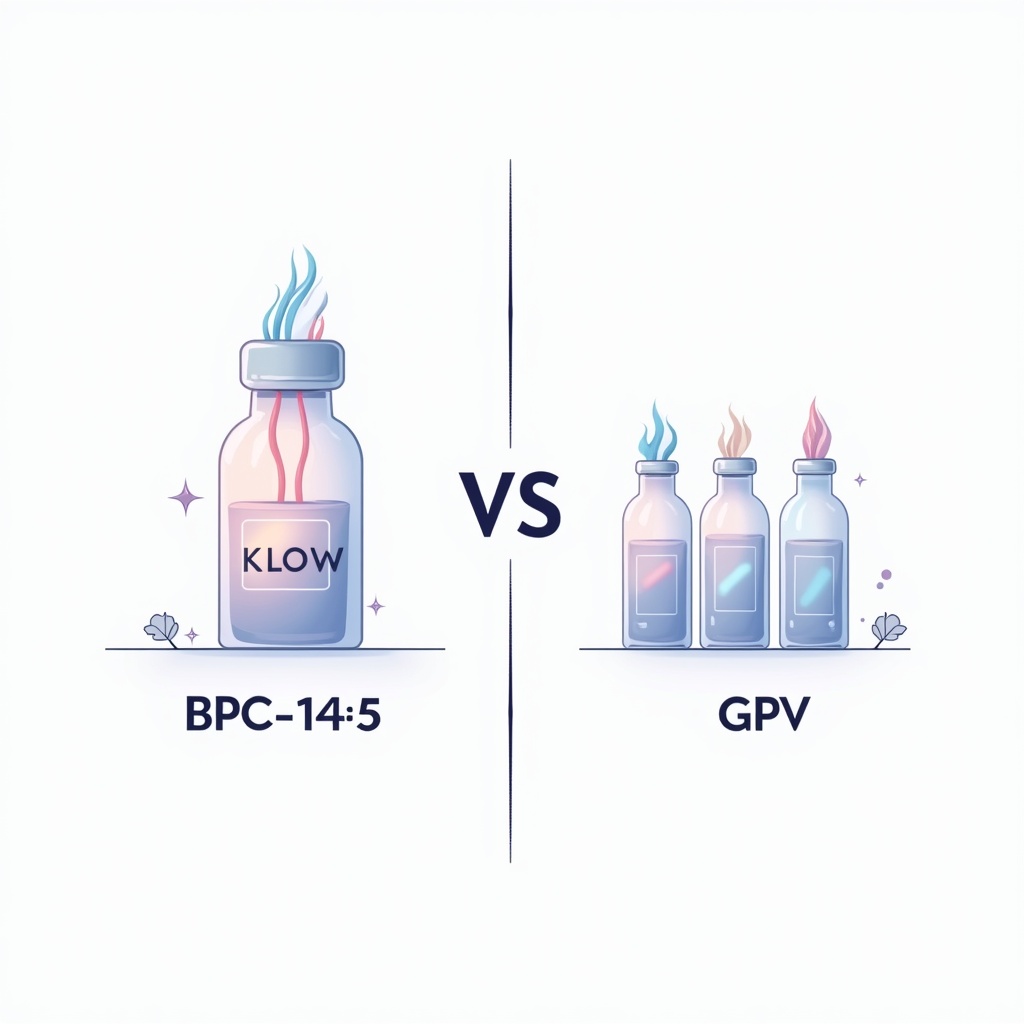
You read about BPC-157. Then TB-500. Then GHK-Cu. Each sounds great on its own. Then you see KLOW, which packs all three (plus KPV) into one vial, and the question becomes obvious: do you buy the ready-made blend, or source each peptide and build the stack yourself?
This is not a rhetorical question. The answer depends on your goals, your budget, and honestly, how much time you want to spend reconstituting vials and doing math with syringes. Let's break it down with actual numbers.
What's actually inside KLOW
[[KLOW|20]] is an 80mg multi-peptide blend containing four compounds:
- BPC-157 — gut and tissue repair, anti-inflammatory, angiogenesis
- TB-500 — systemic tissue repair, cell migration, reduced fibrosis
- KPV — anti-inflammatory tripeptide derived from alpha-MSH
- GHK-Cu — collagen synthesis, wound healing, skin regeneration
The exact ratios are proprietary, but the total active content is 80mg per vial. Each compound has documented research behind it, and several of them share overlapping but complementary repair mechanisms. That overlap is actually the whole point of a blend.
The DIY stack: what you'd need to buy
Let's say you want to replicate KLOW's coverage by purchasing each peptide individually. For a standard 90-day recovery protocol, here's what the math looks like:
[[BPC-157|22]]
Typical dosing: 250–500mcg per day, subcutaneous. At 250mcg daily for 90 days, you need 22.5mg total. That's three 10mg vials at $109 each = $327. Want to run 500mcg/day? Double it: six vials, $654.
[[TB-500|25]]
Standard protocol: loading phase of 5mg per week for 4 weeks (20mg), then maintenance at 2.5mg per week for 8 weeks (another 20mg). Total: 40mg over 12 weeks. That's four 10mg vials at $109 each = $436.
[[GHK-Cu|24]]
Dosing: 200–600mcg per day. At 300mcg daily for 90 days, you need 27mg. One 50mg vial at $55 covers that and leaves some to spare = $55.
KPV
This one's harder to source on its own as a standalone peptide. It's a small tripeptide fragment and not every supplier carries it. When available, expect $50–$80 per vial. Let's budget $65 conservatively.
DIY total for 90 days: ~$883
And that's at the lower dosing end for BPC-157. Push to 500mcg/day and you're looking at $1,200+.
The KLOW route: what it costs
One [[KLOW|20]] vial (80mg) runs $219. If a vial covers roughly 30 days of use, three vials for a 90-day course = $657. The [[KLOW Pen|39]] version (pre-loaded pen format, no reconstitution needed) costs $269 per unit, putting a 90-day course at $807.
Even the pen format comes in cheaper than the DIY route. The standard vial version saves you about $226 compared to buying everything separately.
Cost is only half the story
Money aside, there's the practical reality of running a four-peptide stack from individual vials.
Reconstitution math. Each peptide vial needs to be reconstituted with bacteriostatic water. That means calculating concentrations for four separate vials, drawing four separate injections (or mixing, which introduces stability questions), and tracking four separate expiration timelines. Every vial of reconstituted peptide should be used within about 90 days when refrigerated. If your dosing schedule doesn't line up, you waste product.
Injection volume. Four peptides = either four separate injections per day, or you combine them in one syringe (which many people do, but some peptides can interact in solution). KLOW solves this: one reconstitution, one draw, one injection.
Storage. Four vials in your fridge versus one. Minor point, but anyone who shares a fridge knows space is not infinite.
Consistency. When running separate peptides, it's easy to skip a component. "I'll do the GHK-Cu tomorrow." With a blend, you get the full profile every time you inject. This matters more than people think over a 90-day period.
When DIY stacking makes more sense
The blend isn't always the right call. There are legitimate reasons to go the individual route:
You need custom dosing. Maybe you want 500mcg of BPC-157 but only 100mcg of GHK-Cu. A fixed-ratio blend doesn't let you dial each peptide independently. If you have specific dosing requirements based on experience or a protocol from a practitioner, individual vials give you total control.
You're targeting a single issue. If your only concern is gut healing and you don't care about the skin/collagen benefits of GHK-Cu or the broader anti-inflammatory action of KPV, just buy [[BPC-157|22]] alone. One vial, one peptide, simpler protocol. Not every situation calls for the full recovery stack.
You want to isolate effects. This is the researcher's approach. Start with one peptide, run it for 4–8 weeks, assess response, then add a second. You learn what each compound does for your body specifically. With a blend, you get results but can't attribute them to any single component.
You already have some peptides on hand. Maybe you finished a TB-500 cycle and have two vials left. No point buying a blend when you just need BPC-157 and GHK-Cu to round out the stack.
When the blend wins
General recovery protocols. Post-injury, post-surgery, or just accumulated wear-and-tear. When you want comprehensive tissue repair hitting gut lining, connective tissue, skin, and systemic inflammation all at once, the blend's design matches the use case perfectly.
Simplicity. One vial, one reconstitution, one injection schedule. You don't need a spreadsheet to track four different dosing protocols with different timing requirements. For someone new to peptides, this removes a major source of error and overwhelm.
Cost efficiency. The math above speaks for itself. Even before accounting for the time you spend researching dosing ratios for each individual peptide, the blend is cheaper per 90-day cycle.
Synergy by design. The four peptides in KLOW weren't thrown together randomly. BPC-157 and TB-500 are already one of the most well-documented peptide stacks in the recovery space. BPC-157 handles localized repair (especially gut and tendons), while TB-500 provides systemic tissue repair through thymosin beta-4 upregulation. Adding GHK-Cu brings collagen remodeling and skin healing. KPV adds targeted anti-inflammatory action through NF-kB pathway modulation. These pathways are complementary, not redundant.
The BPC-157 + TB-500 combo: the core of everything
Whether you go blend or DIY, the BPC-157 and TB-500 pairing deserves a closer look because it's the backbone of most recovery stacks.
BPC-157 works primarily through VEGF upregulation (growing new blood vessels) and nitric oxide modulation. It accelerates tendon-to-bone healing, protects gastric mucosa from NSAIDs, and has shown gut-healing properties in multiple models. Its action tends to be more localized to the injection site, though systemic effects exist.
TB-500 (thymosin beta-4 fragment) promotes cell migration and differentiation. It reduces inflammation and fibrosis through actin sequestration. Its effects are more systemic — it circulates and reaches sites of damage throughout the body.
Together, you get localized precision (BPC-157) plus whole-body reach (TB-500). In practice, this means the combo covers injuries you know about and ones you might not. People commonly report improvements in areas they weren't even targeting.
Shelf life and practical notes
All peptides from Peptex have a 90-day shelf life when reconstituted and refrigerated. Unreconstituted lyophilized powder is stable longer (keep it frozen for maximum longevity). A few things to keep in mind:
- Reconstitute with bacteriostatic water, not plain sterile water. The benzyl alcohol in bac water prevents bacterial growth.
- Draw with an alcohol-swabbed needle every time. Contamination is the main reason reconstituted peptides go bad.
- Keep vials away from light and heat. A dedicated fridge drawer works fine.
- If a solution turns cloudy or changes color, discard it. Don't inject mystery liquid.
So which should you pick?
If you're running your first recovery protocol and want a straightforward approach: start with [[KLOW|20]]. One vial, balanced ratios, lower total cost. The pen version ([[KLOW Pen|39]]) removes reconstitution entirely if you want maximum simplicity.
If you're experienced, know your dosing preferences, and want to fine-tune each component: buy individual peptides. [[BPC-157|22]] and [[TB-500|25]] as your foundation, add [[GHK-Cu|24]] for collagen support.
If you're somewhere in between: start with KLOW for your first cycle, pay attention to results, then decide whether individual customization matters to you for cycle two.
Either way, the underlying research supports using these peptides in combination for recovery. The question is just how you want to package that combination.
Not sure which option fits your situation? Message our support team and we'll help you figure out the right protocol.
This article is for informational purposes only and is not medical advice. Consult a qualified healthcare professional before using any peptides. All products are sold for research pur...
PEPTEX dostarcza do Polski — szybka wysyłka, certyfikowana jakość, darmowa dostawa od 150 €.
Czytaj więcej: KLOW vs BPC-157+TB-500+GHK-Cu: mieszanie lub układanie w stosy
💬 Комментарии