GLOW vs KLOW - Comparação de mistura de peptídeos | Peptex
Publicado: 2026-01-26 17:16:00 | PEPTEX Research
Why Blends When You Can Buy Peptides Separately?
Fair question. You could grab BPC-157, TB-500, and GHK-Cu individually — and they would work. But then you are looking at three vials, three reconstitutions, three daily injections, and three separate price tags. Multi-peptide blends from Peptex solve that: everything is already combined in one vial at the right ratios, tested for compatibility. One shot covers multiple mechanisms at once.
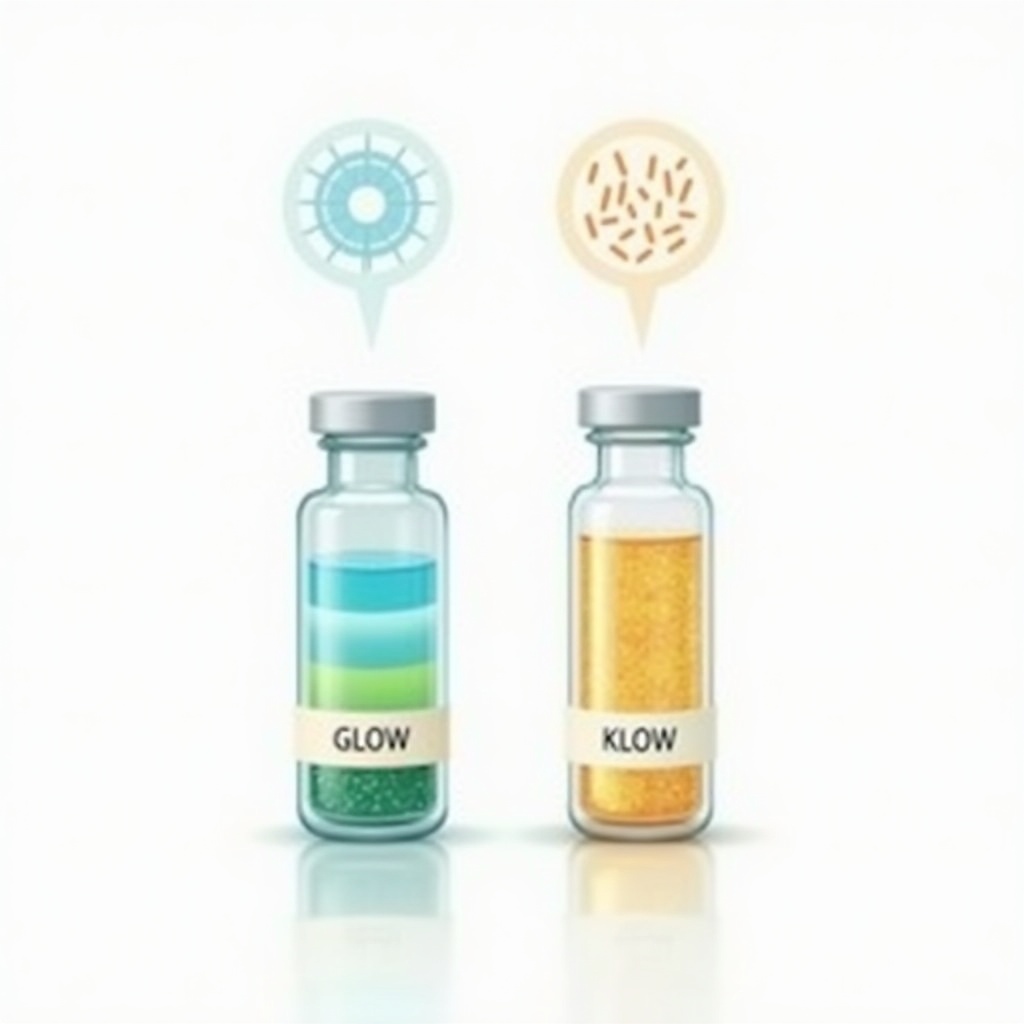
Peptex currently offers two such blends — GLOW and KLOW. They overlap in composition but target different goals. Let's figure out which one is yours.
What's Inside GLOW: Three Peptides, Three Mechanisms
GLOW combines three peptides: BPC-157, TB-500, and GHK-Cu. Each tackles tissue repair through a different pathway, and together they cover recovery from almost every angle.
BPC-157 — Blood Flow and Healing
BPC-157 (Body Protection Compound) is a peptide originally isolated from gastric juice. Its primary strength is angiogenesis: it upregulates VEGF and nitric oxide, promoting the formation of new blood vessels at the injury site. More blood flow means more oxygen and nutrients — which translates to faster healing. BPC-157 also has a well-documented effect on the GI tract, supporting mucosal repair and helping with gut inflammation.
TB-500 — Cell Migration and Anti-Inflammatory Action
TB-500 (Thymosin Beta-4) works through actin binding — the protein responsible for cell motility. When cells can migrate faster to the injury site, wounds close sooner. On top of that, TB-500 delivers significant anti-inflammatory effects, reducing the excessive inflammation that often slows down the repair process.
GHK-Cu — Gene Modulation and Collagen
GHK-Cu is arguably the most versatile component here. This copper-peptide complex modulates the expression of over 4,000 genes, stimulates collagen synthesis, activates stem cells, and functions as an antioxidant. Dr. Tatem rates GHK-Cu individually at A-tier — and for good reason. It is one of the most studied peptides with real, measurable effects on skin quality, wound healing, and even cognitive function.
GLOW Is the Right Choice When:
- You are recovering from a sports injury — torn tendons, ligaments, meniscus damage
- Post-surgery rehab, including ACL reconstruction
- Skin quality improvement and general anti-aging
- Gut health support
- Budget-conscious recovery — three peptides instead of four
What's Inside KLOW: Everything in GLOW Plus KPV
KLOW contains all three GLOW components — BPC-157, TB-500, GHK-Cu — plus a fourth peptide: KPV.
KPV — The Anti-Inflammatory Tripeptide for Scalp and Gut
KPV (Lys-Pro-Val) is a tripeptide derived from alpha-MSH. It delivers potent anti-inflammatory action both systemically and topically. KPV absorbs well through the skin, making it an excellent candidate for scalp therapy. It calms inflammation around hair follicles — one of the key drivers behind hair loss. In the GI tract, KPV also reduces mucosal inflammation, which benefits chronic gut conditions.
KLOW Is the Right Choice When:
- Hair loss is a primary concern — androgenetic alopecia, telogen effluvium, or GLP-1-induced shedding
- Scalp inflammation is an issue (seborrheic dermatitis, folliculitis)
- Chronic inflammatory conditions, including autoimmune-related hair loss
- You are on GLP-1 peptides and want comprehensive protection — face, hair, and muscle
Side-by-Side Comparison: GLOW vs KLOW
| Criteria | GLOW | KLOW |
|---|---|---|
| Composition | BPC-157 + TB-500 + GHK-Cu | BPC-157 + TB-500 + GHK-Cu + KPV |
| Number of Peptides | 3 | 4 |
| Tissue Recovery | ✓ | ✓ |
| Skin and Anti-Aging | ✓ | ✓ |
| Hair and Scalp | Partial (GHK-Cu) | ✓✓ (GHK-Cu + KPV) |
| Anti-Inflammatory | ✓ | ✓✓ (boosted by KPV) |
| Gut Support | ✓ (BPC-157) | ✓✓ (BPC-157 + KPV) |
| Ideal for GLP-1 Stacking | Good | Optimal |
Dr. Kuo's Protocol: Why These Four Peptides for Hair
Dr. Kuo developed a hair loss protocol built around microneedling the scalp with a combination of BPC-157, TB-500, GHK-Cu, and KPV. The peptides are delivered directly to the follicles through microneedling for local effect, while a parallel systemic course of subcutaneous injections provides support from within.
In practice, KLOW is Dr. Kuo's formula in a single vial. All four components of his protocol are already combined. If hair restoration is on your agenda, this is a ready-made solution — no need to source and mix four separate peptides.
Dr. Tatem's Honest Take on Stacks
Dr. Tatem rates the Glow Stack at C-tier as a standalone product. His reasoning: BPC-157 and TB-500 carry mixed evidence compared to GHK-Cu, which earns a solid A-tier on its own.
That is a fair assessment. But there is a nuance worth noting: user reports consistently point to synergy. BPC-157 and TB-500 on their own may not deliver dramatic results, but combined with GHK-Cu, many users report noticeably faster recovery from injuries and visible skin improvement. The science is still catching up with practice — and that is par for the course in the peptide space.
Approach it with calibrated expectations: a blend is not a magic pill. It is a tool that works best alongside proper nutrition, sleep, training, and an overall protocol.
Cost Math: Individual Peptides vs One Blend Vial
Let's do the math. If you buy BPC-157, TB-500, GHK-Cu, and KPV separately, that is four vials, four reconstitutions with bacteriostatic water, and four separate injections every day. Beyond the cost, that is a significant time and convenience penalty.
A single KLOW vial contains all four components at dosages optimized for combined use. You save money and prep time. And if you want to skip reconstitution entirely, there is the KLOW pen — a pre-filled injection pen, ready to go. Pull it out, remove the cap, inject — done.
Practical Protocol
The base protocol for both blends is straightforward:
- Route: Subcutaneous injection (SubQ), abdomen or thigh
- Frequency: Once daily
- Duration for injuries: 4–8 weeks
- Duration for hair and skin: 90 days (full renewal cycle)
- Break: 4–6 weeks between courses
For hair specifically, managing expectations is important. The hair follicle renewal cycle runs roughly 90 days, so don't expect visible changes two weeks in. A three-month course is the minimum for an honest evaluation.
Stacking With GLP-1 Peptides: Dr. Jones' Protocol
If you are running tirzepatide or retatrutide for weight loss, adding a recovery blend is not just optional — it is practically essential. Rapid weight loss on GLP-1 peptides often comes with facial volume loss, hair thinning, and reduced muscle mass.
Dr. Jones, in his five-tier protocol, recommends starting GHK-Cu from day one of a tirzepatide course — to prevent rather than treat the side effects. The logic is simple: it is easier to support skin, hair, and connective tissue proactively than to repair them after the damage is done.
KLOW wins here because of KPV: you get skin support through GHK-Cu, hair protection through the GHK-Cu and KPV combination, plus an anti-inflammatory buffer for the GI tract via BPC-157 and KPV. If you are on a GLP-1 course and hair loss is a real concern, KLOW is the more complete solution.
How to Decide: A Simple Framework
Go with GLOW if:
- Your main goal is recovering from an injury or surgery
- You want better skin quality and anti-aging benefits
- Gut health needs attention
- Budget matters and hair is not a concern
- You want a powerful recovery stack without overspending
Go with KLOW if:
- Hair loss is one of your top priorities
- You deal with chronic inflammation or autoimmune conditions
- You are on GLP-1 peptides and want full-spectrum protection
- Scalp inflammation is bothering you
- You want to cover the maximum number of goals with a single vial
Can't decide? Reach out to our team — we will help you find the right fit for your specific situation.
The Bottom Line
GLOW and KLOW are not competitors — they are tools designed for different jobs. GLOW is the workhorse for tissue recovery, healing, and skin. KLOW is the expanded version with a focus on hair and systemic inflammation. Both save time and money compared to buying peptides individually.
Don't gu...
PEPTEX entrega em Portugal — envio rápido, qualidade certificada, envio gratuito acima de 150 €.
Leia mais: GLOW vs KLOW - Comparação de mistura de peptídeos | Peptex
💬 Комментарии