Холодовий ланцюг доставки пептидів: стабільність при пересиланні
Опубліковано: 2026-01-24 08:00:00 | PEPTEX Research
You order a vial of BPC-157 or Tirzepatide from a European supplier. Three days later, a small parcel arrives at your door. You tear it open, pull out the vial, and pause. Was it too hot in the delivery van? Did the package sit on a sunny loading dock in Madrid for six hours? Is the peptide inside still what you paid for, or has it degraded into a biologically useless fragment?
These questions haunt every peptide buyer at some point. The internet is full of horror stories: melted ice packs, warm parcels, vials rattling loose in oversized boxes. Yet the scientific reality is far more reassuring than forum anxiety suggests. This article breaks down exactly what happens to peptides during shipping, which factors actually threaten stability, and what a responsible supplier does to ensure the product in your hands performs as intended.
The Chemistry of Peptide Degradation
Peptides are short chains of amino acids linked by amide bonds. In solution, those bonds are vulnerable to hydrolysis, oxidation, deamidation, and aggregation. Each pathway has its own trigger. Hydrolysis accelerates above pH 7 and at elevated temperatures. Oxidation targets methionine and tryptophan residues and speeds up with dissolved oxygen and UV light. Deamidation hits asparagine and glutamine side chains, converting them into aspartate or glutamate over days to weeks in aqueous conditions. Aggregation occurs when unfolded peptide chains stick together, forming dimers and higher-order oligomers that lose bioactivity and can provoke immune responses.
That sounds alarming until you realize a critical detail: nearly all of these degradation pathways require water. A peptide dissolved in bacteriostatic water is a ticking clock. A peptide in its lyophilized (freeze-dried) form is, for all practical purposes, a paused clock.
Lyophilization: The Stability Superpower
Lyophilization removes virtually all water from a peptide solution by freezing it and then sublimating the ice under vacuum. The resulting powder typically contains less than 1-3% residual moisture. At these moisture levels, the molecular mobility required for hydrolysis, deamidation, and most oxidation pathways drops to nearly zero.
Published accelerated-stability data on lyophilized peptides tells a consistent story. Researchers at several academic labs have subjected freeze-dried peptide powders to 40 degrees Celsius for periods of four to twelve weeks and found degradation below 2-5% by HPLC. At 25 degrees Celsius, the same powders remain within specification for months, sometimes years. At the temperatures encountered inside a shipping parcel in transit across Europe, even during a summer heatwave, the exposure window is measured in days, not weeks. The math is overwhelmingly in favor of the peptide surviving intact.
This is the single most important fact in the peptide shipping debate: lyophilized peptides are stable at temperatures up to 40 degrees Celsius for weeks. A two-to-five-day transit at ambient temperature, even through southern Europe in July, does not meaningfully degrade a properly manufactured freeze-dried product.
What Actually Matters During Transit
If raw heat is not the primary enemy of a lyophilized peptide in a parcel, what is? Three factors deserve attention:
1. Physical Shock and Vibration
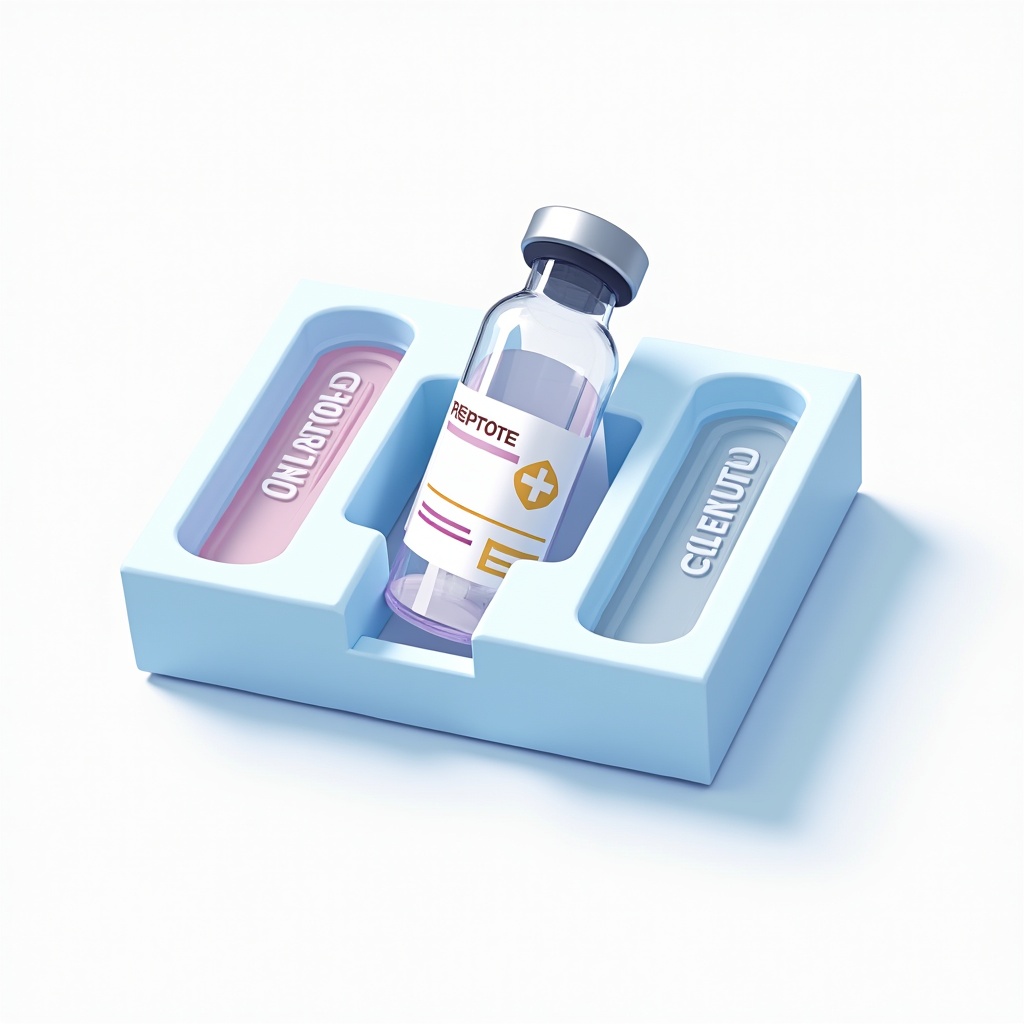
A lyophilized cake or powder can fracture inside the vial if subjected to repeated impacts. While this does not destroy the peptide chemically, it can create fine particles that dissolve unevenly or cling to the rubber stopper, making reconstitution less precise. Responsible packaging uses molded foam inserts or bubble wrap to cushion each vial, preventing direct contact with the box walls. At Peptex, each vial is individually secured inside a rigid foam cradle before the outer carton is sealed. The result: even if the parcel is tossed by a sorting machine, the vial stays immobile.
2. Moisture Ingress
The rubber stopper on a sealed peptide vial is the barrier between the ultra-dry interior and the humid outside world. If the stopper is poorly seated or the aluminum crimp cap is defective, moisture can creep in over time. Humidity inside the vial reintroduces the water that lyophilization removed, reactivating degradation pathways. Quality-controlled vials use butyl rubber stoppers and factory-crimped aluminum seals tested for container closure integrity. This is a manufacturing-level concern, not a shipping-level one, but it underscores why sourcing from a supplier with proper quality checks matters.
3. Ultraviolet Light Exposure
UV light is a potent catalyst for peptide oxidation. Clear glass vials exposed to direct sunlight during transit can accumulate enough photon energy to oxidize sensitive residues. The countermeasure is straightforward: use amber glass vials or opaque secondary packaging. Many shipping envelopes and boxes already block UV, but an extra layer of aluminum foil or lightproof wrap around each vial eliminates the variable entirely.
Cold Chain Logistics: When It Truly Matters
The term "cold chain" refers to a temperature-controlled supply pathway from manufacturer to end user. In pharmaceutical distribution, cold chain usually means maintaining a product at 2-8 degrees Celsius (refrigerated) or -20 degrees Celsius (frozen) from factory floor to pharmacy shelf. This protocol is essential for ready-to-use liquid biologics like insulin, monoclonal antibodies, and reconstituted peptide solutions.
For lyophilized research peptides, however, the cold chain paradigm is often misapplied. The International Council for Harmonisation (ICH) stability guidelines categorize storage conditions into four climate zones. Zone IVb, the most extreme, specifies 30 degrees Celsius and 75% relative humidity as the long-term testing condition. Lyophilized peptides that pass ICH Zone IVb stability testing can be stored at those conditions for their entire labeled shelf life, which often exceeds 24 months.
What this means in practice: a sealed, lyophilized peptide vial does not need refrigeration during the few days it spends in a courier network. Refrigeration extends long-term shelf life once the product is in your hands, but the transit window is so short relative to the stability profile that ambient shipping is scientifically justified.
The Peptex Approach to Shipping Integrity
At Peptex, we operate on a simple principle: the vial that arrives at your door must be indistinguishable from the vial that left our storage. Here is how we achieve that:
- Controlled storage at 2-8 degrees Celsius until the moment of dispatch. This maximizes shelf life by minimizing baseline degradation before the product enters transit.
- Individual vial cushioning with molded foam inserts. No rattling, no impact transfer.
- Opaque, light-blocking packaging as standard on every shipment. UV exposure is eliminated at the packaging stage.
- Tamper-evident seals on every parcel. If the outer packaging has been opened, you will know before you open the inner box.
- Shipping window optimization. Orders are dispatched early in the week to avoid weekend warehouse holds. During extreme summer heat, dispatch timing is adjusted to minimize time in non-climate-controlled vehicles.
These measures collectively address each of the three real risk factors: shock, moisture, and light. Temperature is managed by design, not by adding ice packs that melt and leak and add weight and cost without providing meaningful protection for a freeze-dried product.
Ice Packs and Insulated Boxes: Necessary or Theater?
This is where expectations and evidence diverge. Many buyers assume that a "serious" peptide supplier ships everything with gel ice packs and EPS foam coolers. The visual signal of a cold-packed parcel is reassuring. It suggests care, investment, professionalism.
But the data tells a different story. A gel ice pack inside an insulated box maintains sub-ambient temperatures for roughly 24-36 hours depending on external conditions. After that, the pack reaches thermal equilibrium with the environment, and the parcel temperature matches ambient. For a shipment that takes three to five days across the EU, the ice pack provides a cold window that covers less than half the transit time. The peptide spends the remaining days at ambient temperature regardless.
If the product is lyophilized and stable at 40 degrees Celsius for weeks, those few days at ambient are irrelevant. The ice pack did not add protection; it added weight, cost, and a false sense of security. In some cases, poorly packed ice packs can even damage vials: condensation from melting packs can wet external labels, and the expansion of gel packs during transit can crush improperly secured vials.
This is not an argument against cold-chain shipping. For reconstituted peptide solutions, liquid biologics, and temperature-sensitive hormones, cold chain is non-negotiable. But for sealed, lyophilized peptide powders, the physics and chemistry do not support the added complexity. Professional suppliers invest in what matters: proper lyophilization, airtight sealing, shock protection, and light exclusion. Not theatrical ice packs.
Once It Arrives: Storage Best Practices
While the peptide is robust during transit, long-term storage conditions do affect shelf life. Once you receive your lyophilized peptides, follow these guidelines to maximize potency over time:
- Unreconstituted vials: Store at 2-8 degrees Celsius (refrigerator) for shelf life up to two years. For storage beyond six months, -20 degrees Celsius (freezer) is ideal. Avoid ...
PEPTEX доставляє в Польщу, Чехію, Німеччину та по всій Європі — швидка доставка, сертифікована якість, безкоштовна доставка від 150 €.
Читати далі: Холодовий ланцюг доставки пептидів: стабільність при пересиланні
💬 Комментарии