DSIP vs снодійні: пептидна альтернатива для сну
Опубліковано: 2025-06-03 18:08:00 | PEPTEX Research
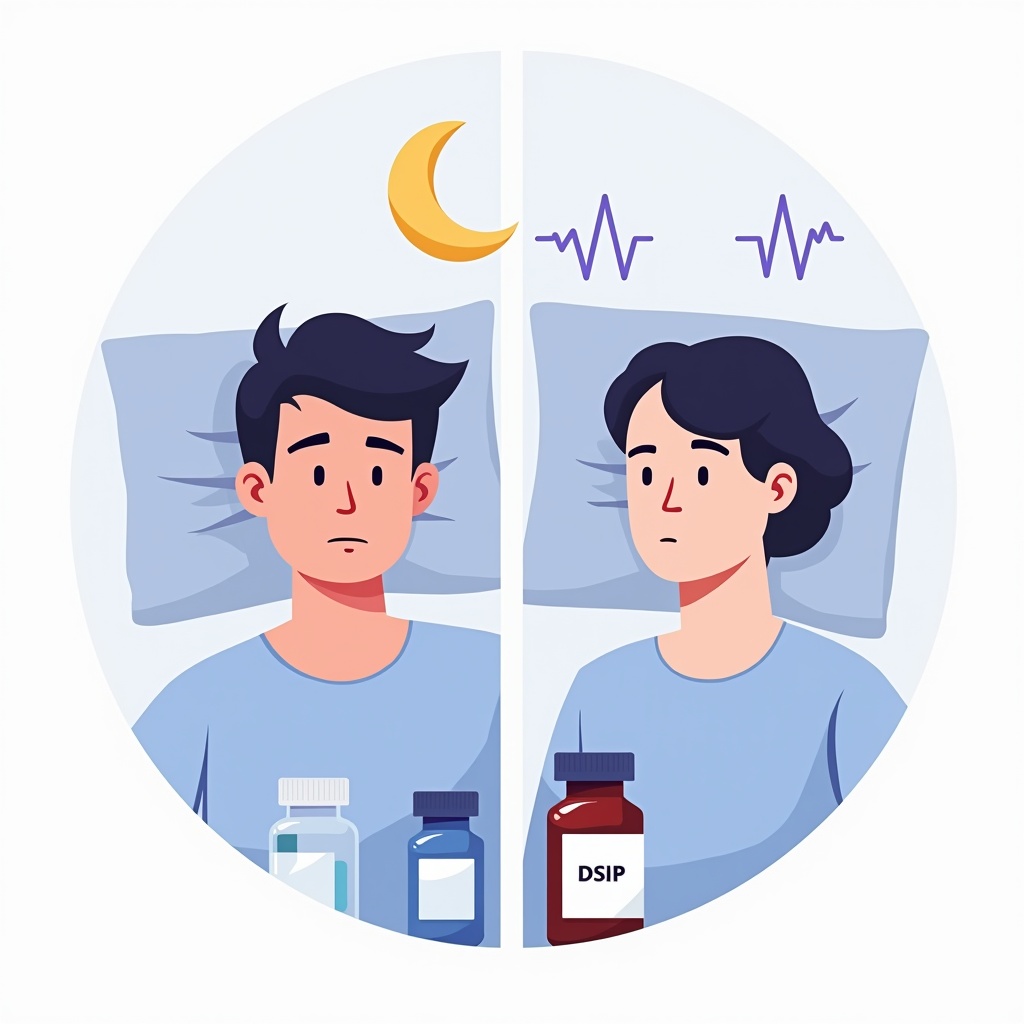
You know the drill. Lie down at 11 PM, stare at the ceiling until 1 AM, drag yourself through the next day on caffeine. After a week of this, you see a doctor, get a prescription for zolpidem or trazodone, and finally sleep. But four months later you can't sleep without the pill either. Sound familiar?
Roughly 50-70 million Americans have a chronic sleep disorder. The global sleep aid market hit $78 billion in 2023. Most of that money goes toward drugs that knock you out but never fix the underlying problem. And there's a class of molecule that almost nobody outside the peptide community talks about: DSIP, delta sleep-inducing peptide.
What prescription sleep aids actually do
Let's be specific about the main categories on the market, because they work through very different mechanisms and carry very different risks.
Benzodiazepines (temazepam, triazolam). These enhance GABA-A receptor activity across the brain. They reduce sleep latency fast but suppress Stage 3 and REM sleep, the stages where actual physical and cognitive recovery happens. Tolerance develops within 2-4 weeks in most people. Withdrawal is well-documented and can include rebound insomnia worse than the original problem. A 2012 BMJ study (Kripke et al.) found that patients prescribed benzodiazepine-type hypnotics had a 3.6x higher hazard ratio for mortality compared to matched controls.
Z-drugs (zolpidem, zaleplon, eszopiclone). Marketed as "non-benzodiazepine" but they hit the same GABA-A receptor, just more selectively. Better than benzos? Somewhat. Zolpidem still suppresses deep sleep architecture in polysomnographic studies. The FDA added a black box warning in 2019 after reports of complex sleep behaviors: people driving, cooking, walking outside, with zero memory the next morning. Tolerance is slower than benzos but still develops, typically within 4-8 weeks of nightly use.
Orexin receptor antagonists (suvorexant, lemborexant). The newest class. These block wake-promoting orexin signals instead of forcing sedation. Sleep architecture is better preserved than with GABA drugs. But they cost $400-500/month out of pocket, cause next-day drowsiness in 6-10% of users, and we have less long-term safety data since they only hit the market in 2014.
Antihistamines and antidepressants repurposed for sleep (trazodone, doxepin, hydroxyzine). These are used off-label constantly. Trazodone is the most-prescribed sleep medication in the US despite never receiving FDA approval as a sleep aid. They produce sedation through antihistamine and serotonin pathways, but the sleep they produce tends to be shallow. Morning grogginess is the most common complaint. And anticholinergic effects from long-term antihistamine use have been linked to cognitive decline in a 2015 JAMA Internal Medicine study (Gray et al.) tracking 3434 older adults over 7 years.
The core problem with all of them
Every drug on that list shares one fundamental limitation: they force sleep through sedation pathways without addressing why you can't sleep in the first place. Your brain doesn't have a zolpidem deficiency. It has a disrupted signaling pattern, and covering that disruption with a chemical sledgehammer doesn't fix the circuitry.
This matters because sleep isn't just "brain off." Proper sleep cycles through light (N1/N2), deep (N3), and REM stages in 90-minute ultradian cycles. Growth hormone release, memory consolidation, immune function, metabolic regulation: each depends on specific stages occurring at the right time and duration. Most prescription aids distort this cycling even while increasing total sleep time.
DSIP: a different approach entirely
Delta sleep-inducing peptide is a nine amino acid neuropeptide (Trp-Ala-Gly-Gly-Asp-Ala-Ser-Gly-Glu) first isolated from rabbit brain tissue in 1977 by Swiss researchers Schoenenberger and Monnier. They found it in the cerebral venous blood of rabbits during electrically induced sleep and demonstrated that injecting this peptide into recipient rabbits increased delta wave activity: the slow, high-amplitude EEG pattern characteristic of deep (Stage 3/4) sleep.
That discovery name is literal. It induces delta sleep. Not sedation. Not unconsciousness. It promotes the specific brainwave pattern associated with the most restorative sleep phase.
How DSIP works in the brain
The mechanism is multi-layered, which is part of why it took decades to untangle.
Endogenous opioid modulation. DSIP interacts with the endogenous opioid system, specifically modulating enkephalin and endorphin signaling. A 1983 study by Iyer and Bhargava showed DSIP altered the binding characteristics of opiate receptors without producing analgesia or dependence at physiological doses. This opioid interaction appears to contribute to its calming and sleep-onset effects without the addiction profile of actual opioids.
Cortisol and stress axis regulation. Multiple studies have documented DSIP's effects on the hypothalamic-pituitary-adrenal (HPA) axis. A 1989 study by Graf and Kastin found that DSIP administration normalized cortisol rhythms in subjects with disrupted patterns. If your cortisol stays elevated at night (a common cause of insomnia in stressed or overtrained individuals), this is directly relevant. High evening cortisol is probably the single most common reason people lie awake with a racing mind.
LH and growth hormone modulation. Research by Obal et al. (1986) demonstrated that DSIP influenced growth hormone secretion during sleep. Since GH release is tightly coupled to deep sleep phases, DSIP's promotion of delta wave activity may work bidirectionally: more delta sleep triggers more GH release, and the peptide itself may directly stimulate GH pathways. This separates DSIP from every prescription sleep aid, none of which enhance GH release.
Glutamate receptor effects. Bhargava (1998) found that DSIP modulated NMDA receptor function, potentially contributing to its neuroprotective properties. This may explain why DSIP improves sleep without cognitive impairment, while GABA-based drugs frequently cause memory issues and morning fog.
DSIP vs prescription aids: head to head
Let's compare on the metrics that actually matter when you're choosing a sleep intervention.
Sleep architecture. Prescription GABA drugs (benzos, Z-drugs) suppress deep sleep and REM. DSIP promotes delta wave activity, meaning it enhances the very sleep stage that others degrade. Orexin antagonists are neutral to mildly positive on architecture, but at 10-15x the cost.
Tolerance and dependence. Benzos produce measurable tolerance in 2-4 weeks. Zolpidem in 4-8 weeks. Multiple studies on DSIP, including a 1987 clinical trial by Schneider-Helmert on chronic insomniacs, showed no tolerance development over the study period and no withdrawal effects upon discontinuation. Subjects actually maintained improved sleep patterns after stopping DSIP.
Next-day impairment. This is a major differentiator. Zolpidem carries an FDA-mandated warning about next-morning driving impairment. Trazodone causes hangover drowsiness in roughly 30% of users. In DSIP studies, no significant next-day psychomotor impairment was reported. Participants woke feeling refreshed rather than groggy.
Side effect profile. Prescription sleep aids come with constipation, dry mouth, headache, complex sleep behaviors, rebound insomnia, dependency. DSIP's documented side effects in clinical observations are minimal: occasional mild headache, slight warmth at injection site. No serious adverse events were reported in published research.
Hormonal effects. Prescription aids either have no effect on or actively suppress growth hormone release during sleep. DSIP appears to enhance it. For athletes, anyone over 35 concerned about recovery, or people dealing with age-related GH decline, this is a significant practical advantage.
What the clinical data shows
Schneider-Helmert (1984) treated 14 chronic insomniacs with DSIP who had failed to respond to benzodiazepine therapy. After 6 evenings of DSIP infusion, subjects showed improved sleep onset latency, increased total sleep time, and better subjective sleep quality. The effects persisted for weeks after treatment ended.
A 1987 follow-up by the same researcher expanded the chronic insomnia cohort and confirmed sustained effects post-treatment. This carry-over effect is the opposite of what happens with prescription aids, where stopping the drug typically produces worse sleep than before you started.
Larbig et al. (1984) demonstrated that DSIP reduced pain perception in chronic pain patients alongside sleep improvement, suggesting the peptide addresses multiple aspects of the stress-sleep-pain axis simultaneously.
Researchers have also investigated DSIP's effects on alcohol and opioid withdrawal, where sleep disruption is a major symptom. Dick et al. (1984) reported that DSIP administration reduced withdrawal severity scores, including sleep disturbance, in alcohol-dependent patients.
Practical use
[[DSIP|41]] is available as a lyophilized peptide in 5mg vials. Reconstitute with bacteriostatic water: add 1-2ml slowly along the vial wall, swirl gently, do not shake. Store reconstituted solution in the refrigerator at 2-8°C and use within 90 days.
Research protocols typically describe subcutaneous injection of 100-250mcg approximately 30-60 minutes before intended sleep onset. At 100mcg per dose, a 5mg vial provides 50 doses. At 250mcg, it covers 20 doses. Some protocols use DSIP for 10-14 consecutive...
PEPTEX доставляє в Польщу, Чехію, Німеччину та по всій Європі — швидка доставка, сертифікована якість, безкоштовна доставка від 150 €.
Читати далі: DSIP vs снодійні: пептидна альтернатива для сну
💬 Комментарии