Як розрахувати дозування пептидів: формула мг, мкг, одиниці та мл Peptex
Опубліковано: 2026-02-27 08:42:00 | PEPTEX Research
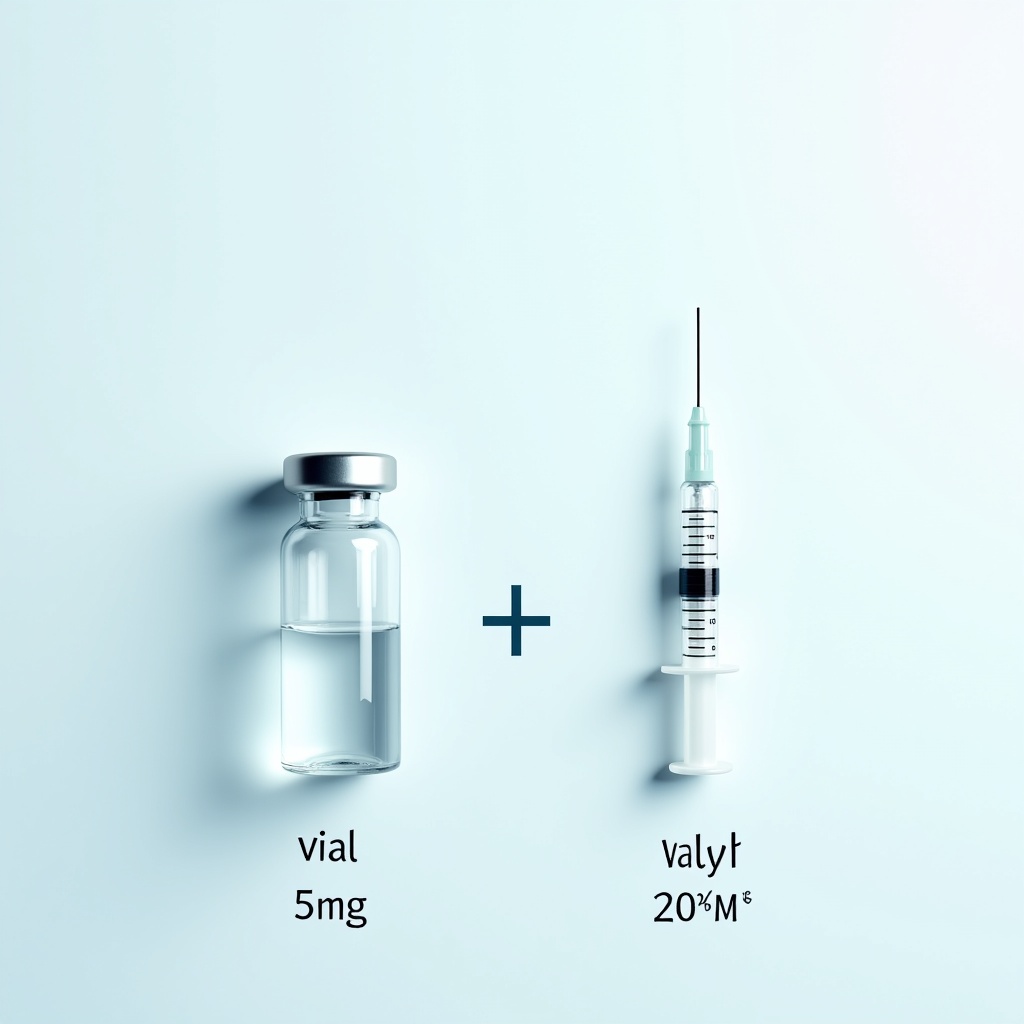
You've probably heard someone say, "I inject 20 units of BPC-157." Sounds precise. Sounds like they know exactly what they're doing. But here's the thing — that statement means absolutely nothing. Twenty units is a volume of liquid in a syringe. What's the concentration? How many milligrams of peptide are actually going in? That's where the real conversation starts.
This guide breaks down peptide dosage calculation from scratch. Milligrams, micrograms, units, milliliters — we'll cover every conversion you need. One formula. Three steps. Works for every peptide you'll ever use.
Mass vs Volume: The Distinction That Changes Everything
Here's the single most important concept in peptide dosing: mass and volume are two completely different things. Confusing them is the source of nearly every dosing error out there.
Mass is how much substance you're taking. Measured in milligrams (mg) or micrograms (mcg). This is your dose. When a protocol says "take 300 mcg of BPC-157 twice daily" — that's mass.
Volume is how much space the liquid takes up. Measured in milliliters (mL), cubic centimeters (cc), or units on an insulin syringe. This is what you draw into the syringe.
Two conversions that never change:
- 1 mL = 1 cc = 100 units. Always.
- 1 mg = 1,000 mcg. Always.
Memorize these. Write them on a sticky note. Tattoo them on your forearm if you have to. These two relationships are the foundation of every calculation you'll ever do.
The Three-Step Formula
All peptide dosage math comes down to three steps. Let's walk through real examples so you can see exactly how it works.
Example 1: [[BPC-157|22]]
Step 1: Calculate your concentration.
You have a 5 mg vial of [[BPC-157|22]]. You add 2 mL of [[Bacteriostatic Water|30]].
Concentration = peptide mass / water volume
5 mg / 2 mL = 2.5 mg/mL = 2,500 mcg/mL
Now you have your key number. Every milliliter of solution contains 2,500 micrograms of peptide.
Step 2: Calculate the volume for your desired dose.
Let's say your target dose is 500 mcg.
Volume = dose / concentration
500 mcg / 2,500 mcg per mL = 0.2 mL
Step 3: Convert to syringe units.
0.2 mL × 100 units per mL = 20 units
Grab your insulin syringe, draw to the "20" mark. Done. You know with certainty that you're injecting exactly 500 mcg of BPC-157.
No advanced math required. Division and multiplication — that's your entire peptide dosage calculator right there.
Example 2: [[TB-500|25]]
Your [[TB-500|25]] vial contains 10 mg. You add 2 mL of [[Bacteriostatic Water|30]].
Concentration: 10 mg / 2 mL = 5 mg/mL
Desired dose: 2.5 mg
Volume: 2.5 mg / 5 mg per mL = 0.5 mL = 50 units
Draw to the "50" mark. Same logic, different numbers.
Example 3: [[GHK-Cu|24]]
Your [[GHK-Cu|24]] vial contains 50 mg. You add 2.5 mL of [[Bacteriostatic Water|30]].
Concentration: 50 mg / 2.5 mL = 20 mg/mL
Desired dose: 4 mg
Volume: 4 mg / 20 mg per mL = 0.2 mL = 20 units
Mark "20" on the syringe. Every single time, same three steps.
The Golden Rule: 10-50 Units Per Injection
Here's a practical tip that rarely appears in protocol guides but matters enormously in practice. Aim for your dose to land between 10 and 50 units per injection.
Under 10 units — too little liquid. The margin of error on an insulin syringe at these volumes becomes significant. The difference between drawing 3 units and 5 units is nearly a 70% change in dose. You're losing accuracy.
Over 50 units — too much liquid for a subcutaneous injection. A large bolus under the skin creates a painful lump that absorbs slowly. Uncomfortable and suboptimal.
What to do when your dose falls outside the sweet spot?
- Getting only 5 units? Use less water when reconstituting. Instead of 2 mL, try 1 mL — the concentration doubles, and you'll need to draw twice the volume for the same dose.
- Getting 80 units? Use more water. Instead of 1 mL, use 2 mL — the concentration halves, and your injection volume becomes more manageable.
The amount of water doesn't change your peptide dose — it only changes the volume of liquid you draw. The peptide in the vial stays the same. You're simply making it more or less diluted.
Insulin Syringe Anatomy
Since we're talking units, let's get clear on syringes. An insulin syringe has three parts: the plunger (what you push), the barrel (the clear tube with markings), and the needle.
The barrel has graduation marks: typically 10, 20, 30, and so on. The needle is usually 29-30 gauge, half an inch long. Thin and short — perfect for subcutaneous injections.
Here's where a common mistake lurks. There are two main types of insulin syringes:
- 50-unit syringe — holds 0.5 mL total. Finer graduations, better for small doses.
- 100-unit syringe — holds 1 mL total. Wider graduations.
The "20" mark on a 50-unit syringe and the "20" mark on a 100-unit syringe represent the exact same volume (0.2 mL). But they look visually different because the scale is different. Always check which syringe you're holding before you draw.
Pro Tip: Label Your Vials
This tip comes from clinical practice and saves a ton of time. Grab a fine-tip Sharpie and write directly on each vial:
- The concentration (e.g., "2,500 mcg/mL")
- Your dose in units (e.g., "500 mcg = 20 units")
- The date you reconstituted
When you have three or four vials in the fridge, you don't want to recalculate every time. Do the math once, write it down, and from then on just draw the right number. This is especially valuable when you're running multiple peptides simultaneously — say [[BPC-157|22]] and [[TB-500|25]] together for recovery.
Quick Reference Table for Peptex Products
| Product | Vial Size | Suggested Water Volume | Concentration | Typical Dose | Syringe Units |
|---|---|---|---|---|---|
| [[BPC-157|22]] | 5 mg | 2 mL | 2,500 mcg/mL | 250 mcg | 10 units |
| [[TB-500|25]] | 10 mg | 2 mL | 5 mg/mL | 1.5 mg | 30 units |
| [[GHK-Cu|24]] | 50 mg | 5 mL | 10 mg/mL | 2 mg | 20 units |
| [[NAD+|14]] | 100 mg | 2 mL | 50 mg/mL | 50 mg | 100 units |
| [[Epithalon|15]] | 10 mg | 2 mL | 5 mg/mL | 5 mg | 100 units |
| [[Ipamorelin|17]] | 5 mg | 2.5 mL | 2 mg/mL | 200 mcg | 10 units |
Notice how most doses in the table fall within our golden range of 10-50 units. The water volumes are chosen specifically for convenient dosing. NAD+ and Epithalon require larger injection volumes due to their higher protocol doses — use a 100-unit syringe for those.
Online Calculators vs Understanding the Math
Sure, peptide dosage calculators exist online. Plug in the numbers, get your answer. Convenient? Absolutely. But here's the question: what happens when the calculator isn't available? Or when you need to quickly recalculate for a different water volume on the fly?
Understanding the math behind dosing gives you independence. You're not tied to an app or a website. You understand what's happening in every vial. And when someone tells you to "inject 20 units" — you can ask the right question: "20 units at what concentration?"
One formula. Three steps. Master it and you'll never need a calculator again.
Bacteriostatic Water: The Only Acceptable Diluent
Since we're talking about reconstitution — let's set the record straight. The only thing you should use to reconstitute peptides is [[Bacteriostatic Water|30]]. Not sterile water for injection. Not filtered water. Not saline.
What's the difference? Bacteriostatic water contains 0.9% benzyl alcohol — a preservative that prevents bacterial growth. This matters because you're not using an entire vial in one injection. You're drawing from it multiple times, piercing the rubber stopper with a needle each time.
Without the preservative, every needle puncture is a potential contamination event. Bacteria enter the vial and begin multiplying in the nutrient-rich solution. Within days, you're no longer injecting pure peptide. Bacteriostatic water prevents this — the benzyl alcohol suppresses microbial growth throughout the vial's usable life.
For acid-sensitive peptides that require a lower pH for stability, [[Acid Water|32]] provides the correct environment for dissolution and storage.
A reconstituted peptide stored in the refrigerator with bacteriostatic water remains viable for up to 90 days. That's another point in its favor — no rush to use the entire vial within a couple of days.
Common Dosing Mistakes to Avoid
Over time, we've seen the same errors come up repeatedly. Here are the big ones:
- Confusing mg and mcg. 1 mg = 1,000 mcg. That's a thousand-fold difference. ...
PEPTEX доставляє в Польщу, Чехію, Німеччину та по всій Європі — швидка доставка, сертифікована якість, безкоштовна доставка від 150 €.
Читати далі: Як розрахувати дозування пептидів: формула мг, мкг, одиниці та мл Peptex
💬 Комментарии