Вісцеральний жир vs підшкірний – пептиди для кожного
Опубліковано: 2025-08-01 19:52:00 | PEPTEX Research
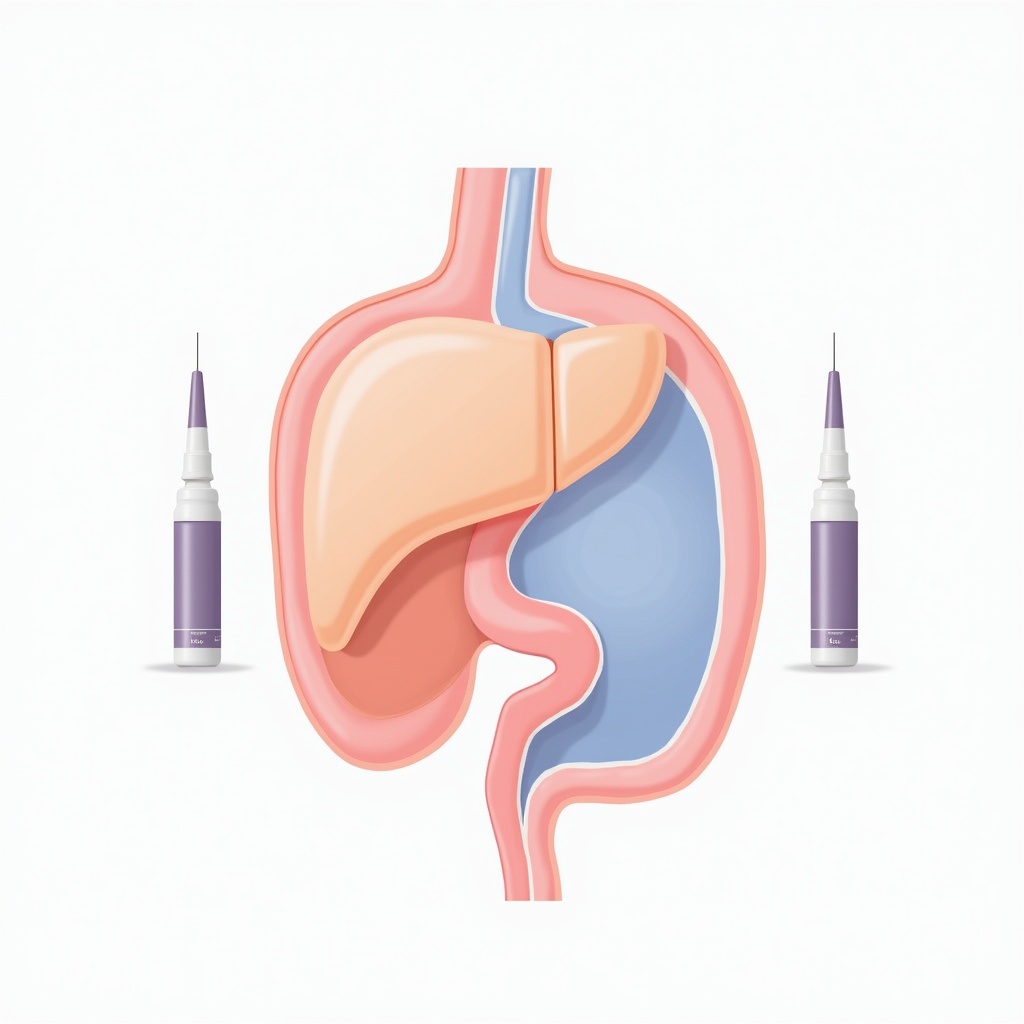
Your bathroom scale shows you lost 8 kilograms. Clothes fit better. But when your doctor orders an abdominal CT scan, the visceral fat layer around your organs has barely moved. What happened? You lost subcutaneous fat, the stuff you can pinch, while the metabolically dangerous fat deeper inside remained stubbornly intact. Different fat depots respond to different biological signals, and understanding this distinction is the difference between looking thinner and actually becoming healthier.
Two types of fat, two completely different problems
Subcutaneous adipose tissue (SAT) sits directly under your skin. It's the fat you grab when you pinch your belly, the fat that accumulates on hips, thighs, and upper arms. It accounts for roughly 80-90% of total body fat in most people. Subcutaneous fat is metabolically relatively benign. It stores energy, provides insulation, and secretes leptin. In moderate amounts, it doesn't significantly increase cardiovascular or metabolic disease risk.
Visceral adipose tissue (VAT) is an entirely different animal. It surrounds your liver, intestines, pancreas, and kidneys inside the peritoneal cavity. You can't pinch it, can't see it directly, and it represents only 10-20% of total fat mass in most individuals. But its metabolic impact is wildly disproportionate to its size. Visceral fat functions almost like an endocrine organ: it releases inflammatory cytokines (IL-6, TNF-alpha), promotes insulin resistance through portal vein delivery of free fatty acids directly to the liver, and correlates independently with cardiovascular mortality, type 2 diabetes, and fatty liver disease.
Here's the clinically relevant point: a person with a normal BMI but high visceral fat (the "TOFI" phenotype, thin outside, fat inside) has worse metabolic markers than someone who is overweight but carries that weight subcutaneously. Waist circumference over 102 cm in men or 88 cm in women correlates more strongly with metabolic syndrome than total body weight does.
Why standard weight loss doesn't solve visceral fat
Caloric restriction and most conventional approaches reduce both fat depots roughly proportionally. You lose some visceral fat, some subcutaneous fat, and unfortunately a fair amount of muscle. Aerobic exercise preferentially targets visceral fat to some degree, but the effect is modest: meta-analyses show about 6-7% reduction in VAT from exercise programs lasting 12 or more weeks, while subcutaneous fat decreases by only 3-4% over the same period.
This is where peptide-based interventions become interesting. Different peptides interact with different receptor systems, lipolytic pathways, and hormonal cascades. Some primarily mobilize subcutaneous fat. Others selectively reduce visceral depots. And a few do both, though through entirely separate mechanisms.
Tesamorelin: the visceral fat specialist
Tesamorelin is the only peptide with FDA-approved data specifically demonstrating visceral fat reduction. It's a growth hormone-releasing hormone (GHRH) analogue, a 44-amino acid synthetic peptide that stimulates pulsatile GH release from the anterior pituitary. What makes tesamorelin unique isn't just that it boosts GH. It's the downstream metabolic cascade that GH triggers specifically in visceral adipocytes.
Growth hormone activates hormone-sensitive lipase (HSL) in fat cells, initiating lipolysis. But the density of GH receptors differs dramatically between fat depots. Visceral adipocytes express substantially higher concentrations of GH receptors compared to subcutaneous fat cells. When tesamorelin elevates GH levels, visceral fat cells get a much stronger lipolytic signal than subcutaneous ones. This receptor density differential is the molecular basis for selective visceral fat reduction.
The clinical data is unusually clear for a peptide. In the pivotal Phase III trials involving HIV-associated lipodystrophy patients (a population with dramatically elevated visceral fat), tesamorelin reduced trunk fat by 18% over 26 weeks. Visceral fat area on CT imaging decreased by approximately 15-18%, while subcutaneous fat was minimally affected. The effect appeared on imaging by week 13. Liver fat (another visceral depot) also decreased. Importantly, lean body mass was preserved or slightly increased, distinguishing tesamorelin from caloric restriction, which typically erodes muscle.
Beyond direct lipolysis, tesamorelin reduces hepatic triglyceride content through GH-mediated suppression of de novo lipogenesis in the liver. This is relevant because non-alcoholic fatty liver disease (NAFLD) almost always co-exists with elevated visceral fat. You're treating two interconnected problems with a single intervention.
Dosing in clinical trials: 2 mg subcutaneously once daily. Effects plateau around 6-12 months. One practical note: tesamorelin elevates IGF-1, so periodic blood work monitoring is appropriate.
AOD-9604: subcutaneous fat mobilization without the GH side effects
AOD-9604 takes a different approach. It's a modified fragment of human growth hormone, specifically amino acids 177-191 with an added tyrosine. This fragment retains the lipolytic activity of full-length GH but lacks the growth-promoting and diabetogenic effects. The result is fat mobilization without the IGF-1 elevation, fluid retention, or insulin resistance that full GH can produce.
AOD-9604's mechanism operates through beta-3 adrenergic receptor pathways and direct stimulation of lipolysis in adipose tissue. Unlike tesamorelin, its receptor affinity profile doesn't show strong preferential binding to visceral fat cells. The lipolytic effect is more evenly distributed across subcutaneous depots, making it better suited for reducing the fat you can see and measure with calipers.
Preclinical studies in obese Zucker rats showed dose-dependent fat loss without changes in food intake or IGF-1 levels. The human data is more limited but directionally consistent: a 12-week clinical trial demonstrated statistically significant reduction in body weight and abdominal subcutaneous fat compared to placebo, though the absolute magnitude was modest.
Where AOD-9604 is particularly practical: it's well-tolerated, doesn't require blood work monitoring for IGF-1 or glucose, and can be combined with other agents. It won't solve a visceral fat problem on its own, but for someone whose primary concern is subcutaneous adiposity, particularly abdominal subcutaneous fat, it addresses that compartment directly.
Standard research dosing: 300-500 mcg subcutaneously once daily, typically administered in the morning on an empty stomach. Some protocols use a 5-day-on, 2-day-off schedule.
Tirzepatide: the dual-agonist that hits both depots
Tirzepatide operates through a fundamentally different mechanism than the previous two peptides. It's a dual GIP/GLP-1 receptor agonist, simultaneously activating glucose-dependent insulinotropic polypeptide and glucagon-like peptide-1 receptors. This dual activation creates metabolic effects that neither pathway achieves alone.
The SURMOUNT trial program demonstrated total body weight loss of 20-25% at the highest doses (15 mg weekly). But the compositional analysis is what matters for this discussion. Sub-studies using DEXA and CT imaging showed that tirzepatide reduces both visceral and subcutaneous fat, with visceral fat decreasing by approximately 30-40% in some cohorts. That's a substantially larger visceral fat reduction than most interventions achieve.
The GIP component appears to play a significant role in the visceral fat effect. GIP receptors are expressed on adipocytes and appear to modulate lipid storage and mobilization. When combined with GLP-1's appetite suppression, delayed gastric emptying, and enhanced insulin sensitivity, the result is a broad metabolic reset that pulls fat from multiple depots simultaneously.
Tirzepatide's advantage is comprehensive metabolic improvement: HbA1c reduction, blood pressure improvement, triglyceride reduction, and fat loss across all compartments. The downside is the caloric deficit it creates. Without adequate protein intake (minimum 1.6 g/kg/day, ideally 2.0+ g/kg/day) and resistance training, 30-40% of weight lost will be lean tissue rather than fat. Managing this requires deliberate nutritional strategy.
Dosing follows a titration schedule: 2.5 mg weekly for the first 4 weeks, then 5 mg, with optional increases to 7.5 mg, 10 mg, 12.5 mg, and 15 mg based on tolerance and response. Most fat loss occurs between 5 mg and 10 mg doses.
Comparing the three: which peptide for which goal
The choice between these peptides depends on which fat compartment you're targeting and what metabolic outcomes you need.
Your primary concern is visceral fat around organs: Tesamorelin is the strongest evidence-based option for selective visceral fat reduction. It preserves lean mass, specifically reduces hepatic and intra-abdominal fat, and has robust Phase III trial data. Best for individuals with elevated waist circumference, fatty liver, or metabolic syndrome markers who aren't necessarily overweight overall.
Your primary concern is subcutaneous fat (visible fat): AOD-9604 addresses subcutaneous depots without the GH-related side effect profile. It's a cleaner, simpler approach for body composition improvement when metabolic markers are already reasonable. Works well stacked with exercise protocols targeting stubborn subcutaneous areas.
You need total body recomposition, both fat depots plus metabolic improvement: PEPTEX доставляє в Польщу, Чехію, Німеччину та по всій Європі — швидка доставка, сертифікована якість, безкоштовна доставка від 150 €.
Читати далі: Вісцеральний жир vs підшкірний – пептиди для кожногоArticles
Get in touch
Choose how you'd like to reach us
Special offer for you
Enter your email and get 15% off your first order
🪙 Оплата криптовалютой
Шаг 1 из 2 — выберите валюту
Support
Choose a convenient way to contact us
Проверка подлинности
Введите серийный код с упаковки
💬 Комментарии