Hormônios de incretina explicados: GLP-1, GIP, Glucagon
Publicado: 2026-04-04 08:20:00 | PEPTEX Research
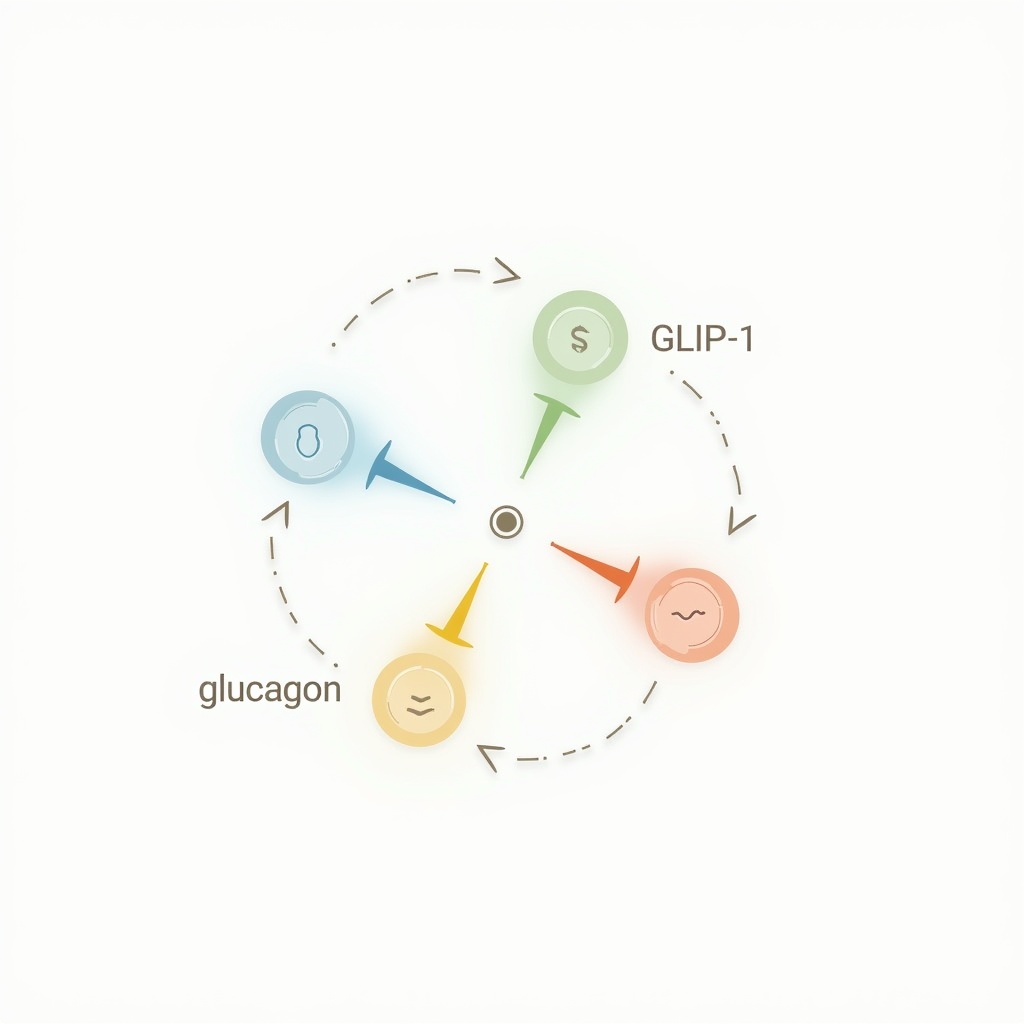
Every weight-loss peptide conversation eventually circles back to three letters: GLP-1. But GLP-1 is only one piece of a larger hormonal system that your gut and pancreas use to manage energy after every meal. Understanding the full picture — GLP-1, GIP, and glucagon — explains why newer compounds are outperforming older ones, and where the field is heading next.
The incretin system: a 90-second primer
When food hits the upper intestine, specialized enteroendocrine cells release two hormones before glucose even reaches the bloodstream: GLP-1 (glucagon-like peptide-1) and GIP (glucose-dependent insulinotropic polypeptide). Together, these account for roughly 50-70% of the insulin response to an oral glucose load — a phenomenon called the incretin effect, first described in the 1960s and quantified more precisely in the 1980s.
Glucagon, released by pancreatic alpha cells, works in a seemingly opposite direction: it raises blood glucose by signaling the liver to release stored glycogen. But as you'll see, its role in weight management is more nuanced than "the hormone that makes blood sugar go up."
GLP-1: the one you've heard about
GLP-1 became the most discussed hormone in metabolic medicine for good reason. Its receptor sits on pancreatic beta cells, brain neurons, gastric smooth muscle, and several other tissue types. Activating it produces a coordinated set of effects.
Insulin secretion. GLP-1 amplifies glucose-dependent insulin release. The key word is "glucose-dependent" — it doesn't force insulin out when blood sugar is already normal, which dramatically lowers hypoglycemia risk compared to older insulin secretagogues like sulfonylureas.
Appetite suppression. GLP-1 receptors in the hypothalamus and brainstem reduce hunger signaling. Functional MRI studies show that GLP-1 receptor agonists decrease activation in brain regions associated with food reward and craving. This is not willpower supplementation. It is a direct neurochemical shift in how the brain evaluates caloric intake.
Gastric emptying. GLP-1 slows the rate at which food leaves the stomach. This extends satiety after meals and flattens the postprandial glucose spike. Clinically, it means people feel full longer and eat less at subsequent meals without conscious restriction.
Glucagon suppression. Native GLP-1 reduces glucagon secretion from alpha cells, contributing to lower fasting and postprandial glucose. This partly explains why GLP-1 agonists improve HbA1c so consistently in type 2 diabetes trials.
The problem with native GLP-1 is its half-life: approximately 2 minutes. The enzyme DPP-4 degrades it almost immediately. Every pharmaceutical GLP-1 agonist works by resisting DPP-4 breakdown, extending the signal from minutes to hours or days.
GIP: the underestimated partner
For decades, GIP was considered irrelevant to weight loss. Some researchers even argued it was obesogenic because GIP receptor knockout mice resisted diet-induced obesity. The story turned out to be more complicated.
GIP is actually the dominant incretin in healthy people — it accounts for a larger share of the incretin effect than GLP-1 under normal conditions. Its receptor is expressed on pancreatic beta cells, adipocytes, bone cells, and neurons in the hypothalamus and area postrema.
Insulin potentiation. GIP enhances glucose-dependent insulin secretion through a different signaling cascade than GLP-1. When both pathways activate simultaneously, the insulin response is more than additive — they synergize.
Fat tissue effects. GIP receptors on adipocytes influence lipid storage and mobilization. The relationship is dose- and context-dependent. At pharmacological doses in GIP receptor agonists, the net effect appears to improve lipid handling and reduce ectopic fat deposition (fat accumulation in places like the liver where it causes metabolic damage).
Nausea mitigation. This may be GIP's most underappreciated clinical contribution. GLP-1 agonists cause nausea by slowing gastric emptying and through direct brainstem activation. GIP receptor agonism appears to partially offset this. Dual GLP-1/GIP agonists consistently show lower rates of gastrointestinal side effects at equivalent weight-loss efficacy compared to pure GLP-1 agonists. Less nausea means better adherence and faster dose escalation.
Bone density. GIP receptors on osteoblasts and osteoclasts appear to mediate a bone-protective effect. Early clinical data from tirzepatide trials suggest preservation of bone mineral density during significant weight loss — a concern with GLP-1-only agonists and caloric restriction generally.
Glucagon: not just the counter-regulatory hormone
Glucagon's reputation as "the hormone that raises blood sugar" made researchers initially cautious about activating its receptor for metabolic therapy. Why would you want to raise glucose in someone who might be diabetic?
The answer lies in what glucagon does beyond glycogenolysis.
Energy expenditure. Glucagon receptor activation increases resting energy expenditure through thermogenesis. It stimulates hepatic fatty acid oxidation and promotes the browning of white adipose tissue. In human studies, glucagon infusion increases energy expenditure by 5-15% above baseline. This is a meaningful addition to the caloric deficit created by appetite suppression.
Lipid metabolism. Glucagon drives the liver to oxidize fatty acids rather than package them into VLDL particles. This contributes to reductions in liver fat, circulating triglycerides, and LDL cholesterol. For patients with metabolic-associated steatotic liver disease (MASLD, formerly NAFLD), glucagon receptor agonism offers a mechanistically distinct benefit.
Amino acid homeostasis. Glucagon regulates amino acid catabolism in the liver. Disrupted glucagon signaling leads to alpha-cell hyperplasia and elevated circulating amino acids. This axis is still being mapped, but it connects glucagon to protein metabolism in ways that may affect body composition during weight loss — specifically, the ratio of fat mass lost versus lean mass preserved.
The glycemic risk of glucagon receptor activation is manageable when combined with GLP-1 agonism. GLP-1 suppresses excessive glucose release while glucagon's metabolic benefits are preserved. This is why triple agonists include both signals.
From one receptor to three: the evolution of incretin therapy
The pharmacological progression follows the biology directly.
Single agonists (GLP-1 only). Semaglutide and liraglutide target one receptor. They reduce body weight by approximately 15-17% over 68 weeks in clinical trials (the STEP program). Effective, but with a ceiling.
Dual agonists (GLP-1 + GIP). [[Tirzepatide|10]] activates both GLP-1 and GIP receptors in a single molecule. The SURMOUNT-1 trial demonstrated up to 22.5% body weight reduction at the highest dose — roughly 5-7 percentage points beyond what GLP-1-only agonists achieve. Nausea rates were comparable or lower despite greater efficacy. This confirmed that GIP co-agonism adds real clinical value, not just incremental novelty. Peptex carries tirzepatide in research-grade form for investigators studying dual agonist pathways.
Triple agonists (GLP-1 + GIP + glucagon). [[Retatrutide|11]] targets all three receptors. Phase 2 data showed up to 24.2% body weight reduction at 48 weeks, with dose-dependent responses suggesting the ceiling hasn't been reached. The glucagon component adds energy expenditure increases and lipid metabolism improvements that GLP-1/GIP alone don't fully achieve. The trade-off is more complex dose-finding: too much glucagon receptor activation and you get hyperglycemia; too little and you lose the thermogenic benefit.
[[Mazdutide|13]] takes a different approach to the multi-agonist concept — it combines GLP-1 and glucagon receptor agonism as a dual agonist, omitting GIP. Phase 3 data from the GLORY trials showed significant weight loss and metabolic improvements, with particularly strong effects on liver fat and lipid profiles. The GLP-1/glucagon combination prioritizes the energy expenditure and hepatic benefits of glucagon while relying on GLP-1 alone for the incretin-mediated insulin and appetite effects. This provides a useful comparison point: mazdutide's efficacy profile helps isolate the relative contributions of GIP versus glucagon when combined with GLP-1.
Why multi-receptor targeting works better
The advantage of multi-agonists isn't simply "more targets, more weight loss." Several specific mechanisms compound.
Complementary appetite pathways. GLP-1 and GIP reduce appetite through overlapping but distinct neuronal circuits. Activating both produces a more robust and sustained reduction in caloric intake than either alone. The clinical observation matches the biology: people on dual agonists report less hunger and fewer cravings.
Synergistic insulin secretion. The beta cell responds to GLP-1 and GIP through different intracellular signaling cascades (cAMP-dependent but involving different effector proteins). Simultaneous activation produces an insulin response greater than the sum of individual stimulation. This improves glycemic control while maintaining glucose-dependence.
Energy expenditure offset. GLP-1 agonists alone tend to reduce resting metabolic rate as weight decreases — a predictable metabolic adaptation. Glucagon receptor activation directly counteracts this by increasing hepatic thermog...
PEPTEX entrega em Portugal — envio rápido, qualidade certificada, envio gratuito acima de 150 €.
Leia mais: Hormônios de incretina explicados: GLP-1, GIP, Glucagon
💬 Комментарии